Interactive Guitar Scale LibraryModes, formulas and the whole neck
46 scales and modes, each shown four ways: on a circle with every mode of its family, as a formula of whole and half steps, across the neck in five CAGED positions, and as the chords it holds. Pick a root, pick a scale, and hear it.
Works on desktop, tablet and phone. Nothing to install.
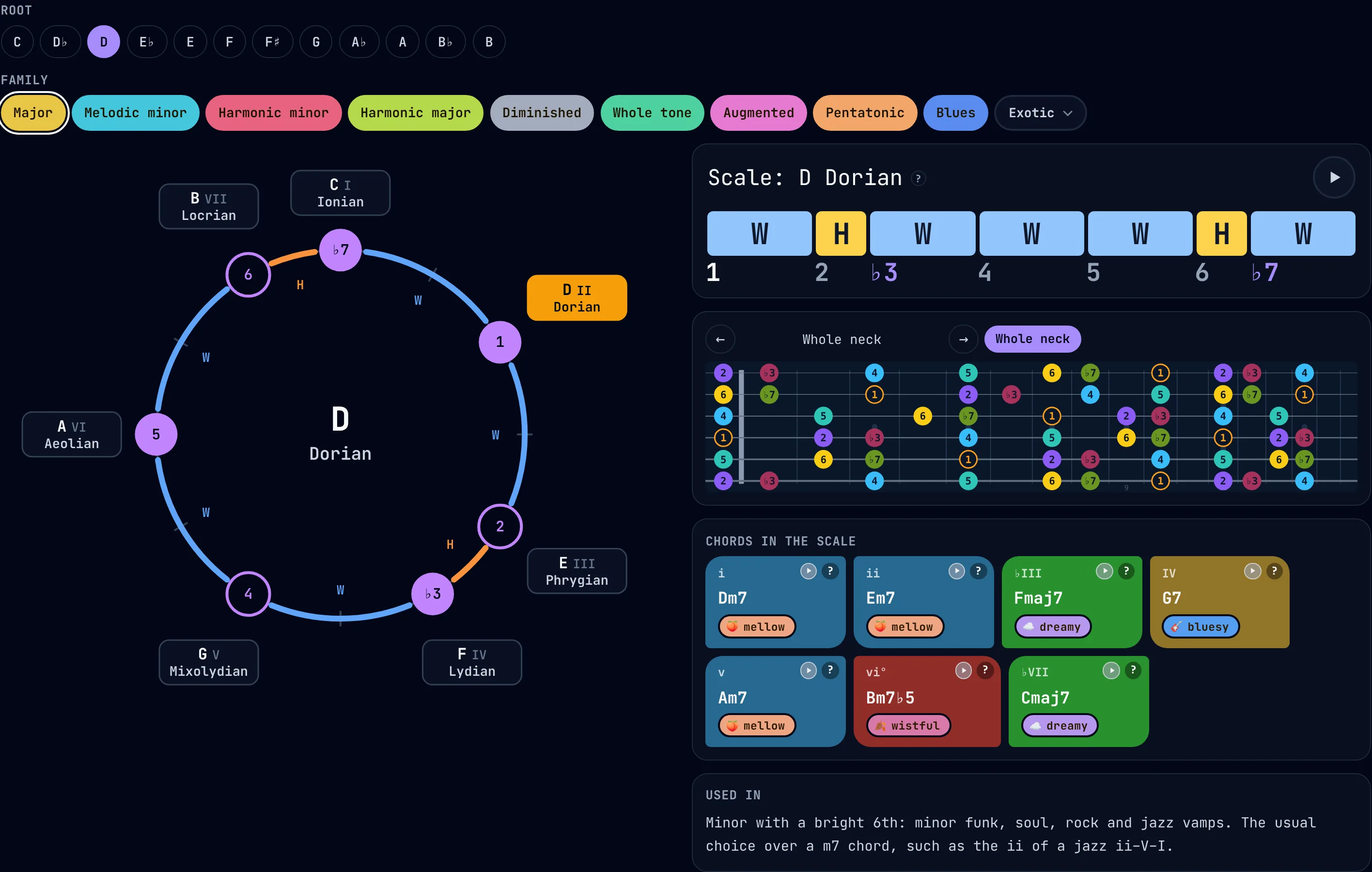
- Every mode at onceA family's parent scale on a circle, with each mode round it.
- Formulas you can readDegrees and the whole and half steps between them.
- The whole neckAll of it at once, or one CAGED position at a time.
- The chords insideEvery 7th chord in the scale, lit up on the neck.
Seven modes, one set of notes
A mode is a scale started from one of its own notes. The circle draws the parent scale, here C major, with its whole and half steps round the ring and a label for each mode at the note it starts on. D Dorian is C major from D to D: the same seven notes, a different home, and so a different sound. Click any label to move home to that note.
The Roman numeral on each label is the mode's place in the parent scale, so the circle is also the answer to "which major key is A Aeolian in?"
Turn the circle →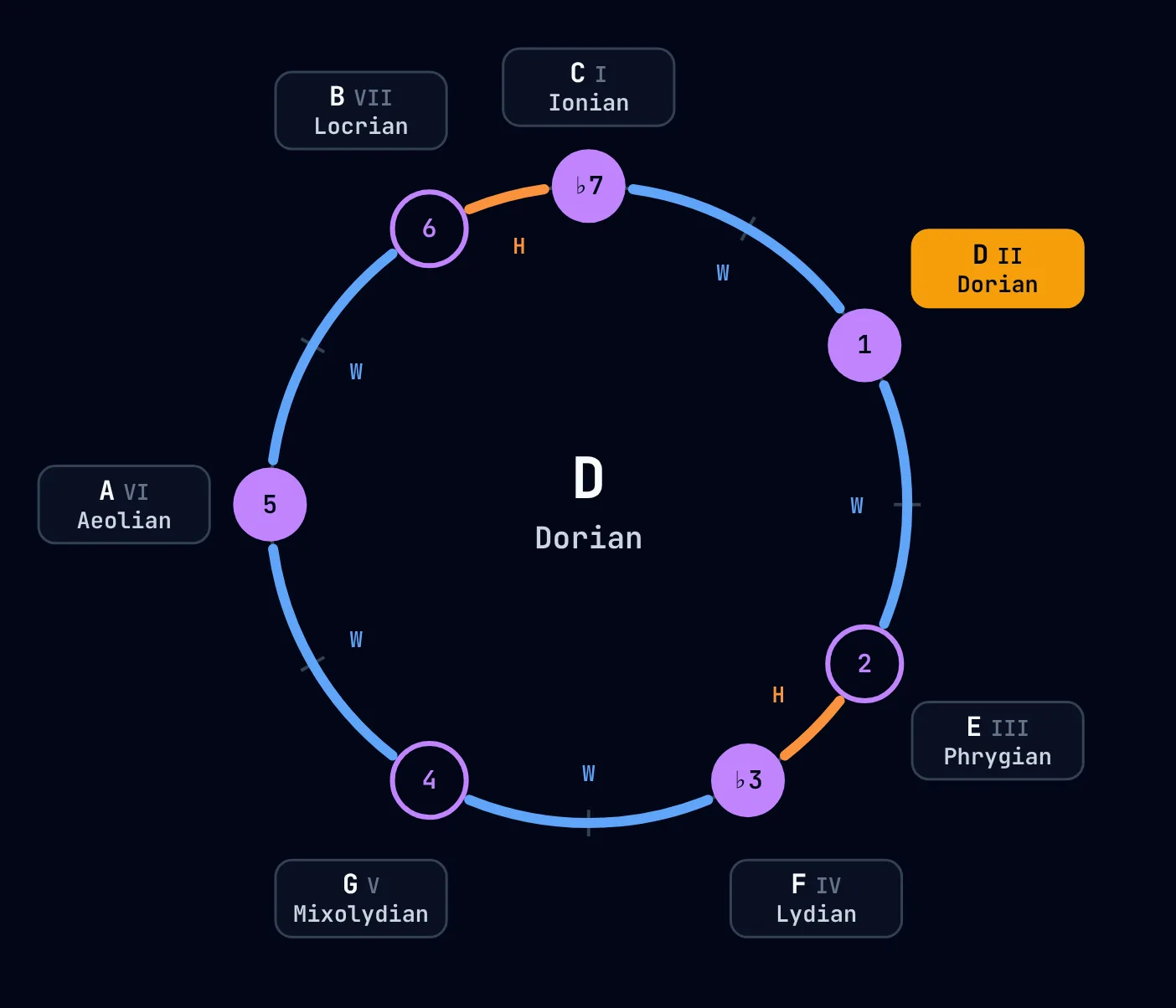
The seven modes and where they are used
| Mode | Formula | Steps | Used in |
|---|---|---|---|
| IonianMajor | 1 2 3 4 5 6 7 | W W H W W W H | Plain major: pop, folk, rock and classical melodies in major keys. Over a maj7 chord, pass through the 4th rather than rest on it. |
| Dorian | 1 2 ♭3 4 5 6 ♭7 | W H W W W H W | Minor with a bright 6th: minor funk, soul, rock and jazz vamps. The usual choice over a m7 chord, such as the ii of a jazz ii–V–I. |
| Phrygian | 1 ♭2 ♭3 4 5 ♭6 ♭7 | H W W W H W W | Dark minor with a ♭2: metal riffs, Spanish-flavoured music and modal jazz. Over a minor chord when the ♭2 is meant to be heard. |
| Lydian | 1 2 3 ♯4 5 6 7 | W W W H W W H | Major with a raised 4th: film scores, dreamy pop and jazz over maj7♯11 chords. At home over the IV chord of a major key. |
| Mixolydian | 1 2 3 4 5 6 ♭7 | W W H W W H W | Major with a ♭7: blues-rock, classic rock, funk and folk over dominant 7 chords. The sound of I–♭VII–IV progressions. |
| AeolianNatural minor | 1 2 ♭3 4 5 ♭6 ♭7 | W H W W H W W | Natural minor: rock, pop and metal in minor keys, over progressions like i–♭VI–♭VII and i–iv–v. |
| Locrian | 1 ♭2 ♭3 4 ♭5 ♭6 ♭7 | H W W H W W W | The darkest mode, built on a diminished chord: over m7♭5 chords in jazz and in some metal riffs. Rarely a home key. |
Whole steps, half steps and degrees
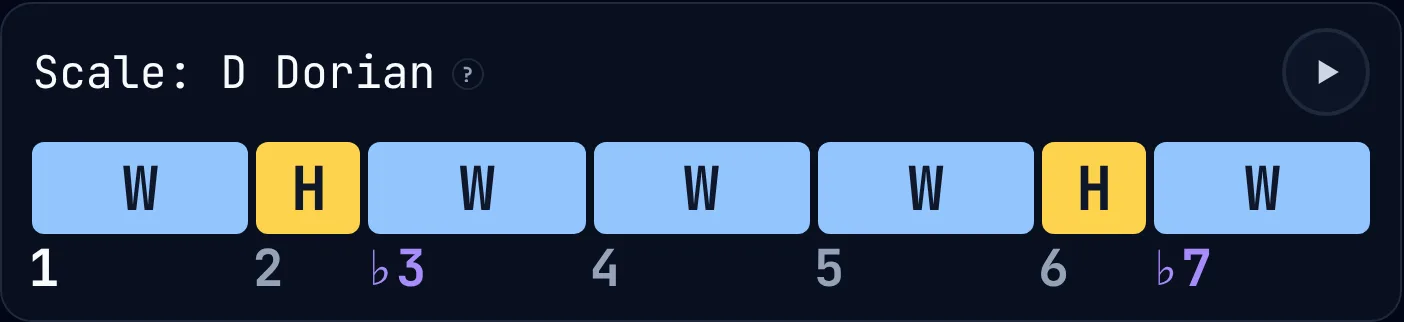
Every scale is a pattern of gaps. The formula bar draws them as blocks: W for a whole step of two frets, H for a half step of one, 1½ for three. Under each block is the degree it lands on, with the notes that differ from major marked ♭ or ♯. D Dorian reads W H W W W H W, and its ♭3 and ♭7 say it is a minor mode with a natural 6th.
Press play to hear the scale run up, with the formula lighting up as it goes. Learn a handful of these patterns and you can build any scale from any note without a chart.
Five positions, one for each CAGED shape
A scale covers the whole neck, but you play it a few frets at a time. The library splits it into five positions, one round each CAGED chord shape, and names each by its shape and frets. Step through them in order and they link up into the whole fretboard.
- Step to the next position, here the G shape at frets 2 to 6.
- Show the whole neck again.
Roots are ringed in every position, so you can always find your way back to the note the scale is named after.
The CAGED system explained →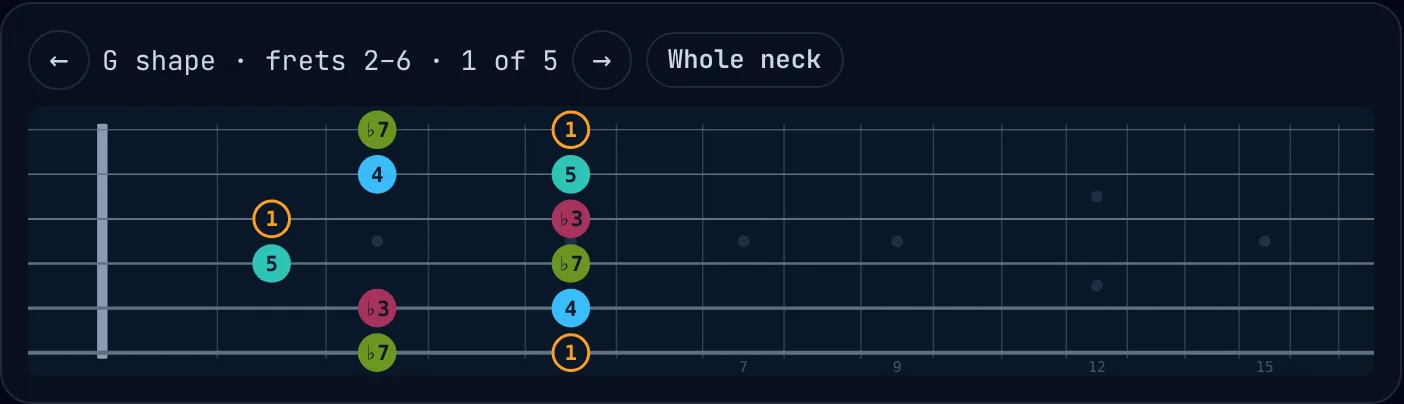
The chords hiding in every scale
Stack every other note of a scale on each of its degrees and you get its chords: its harmony. Every seven-note scale shows its seven 7th chords with their Roman numerals and a word for their mood. Click one and its notes light up on the circle and the neck, so you see the chord inside the scale you are soloing with.
- G7, the IV of D Dorian. Its 3rd is B, Dorian's natural 6th, which is why Dm7 to G7 is the Dorian sound.
Each chord plays on its own and opens in the chord library with its voicings.
How chords are built →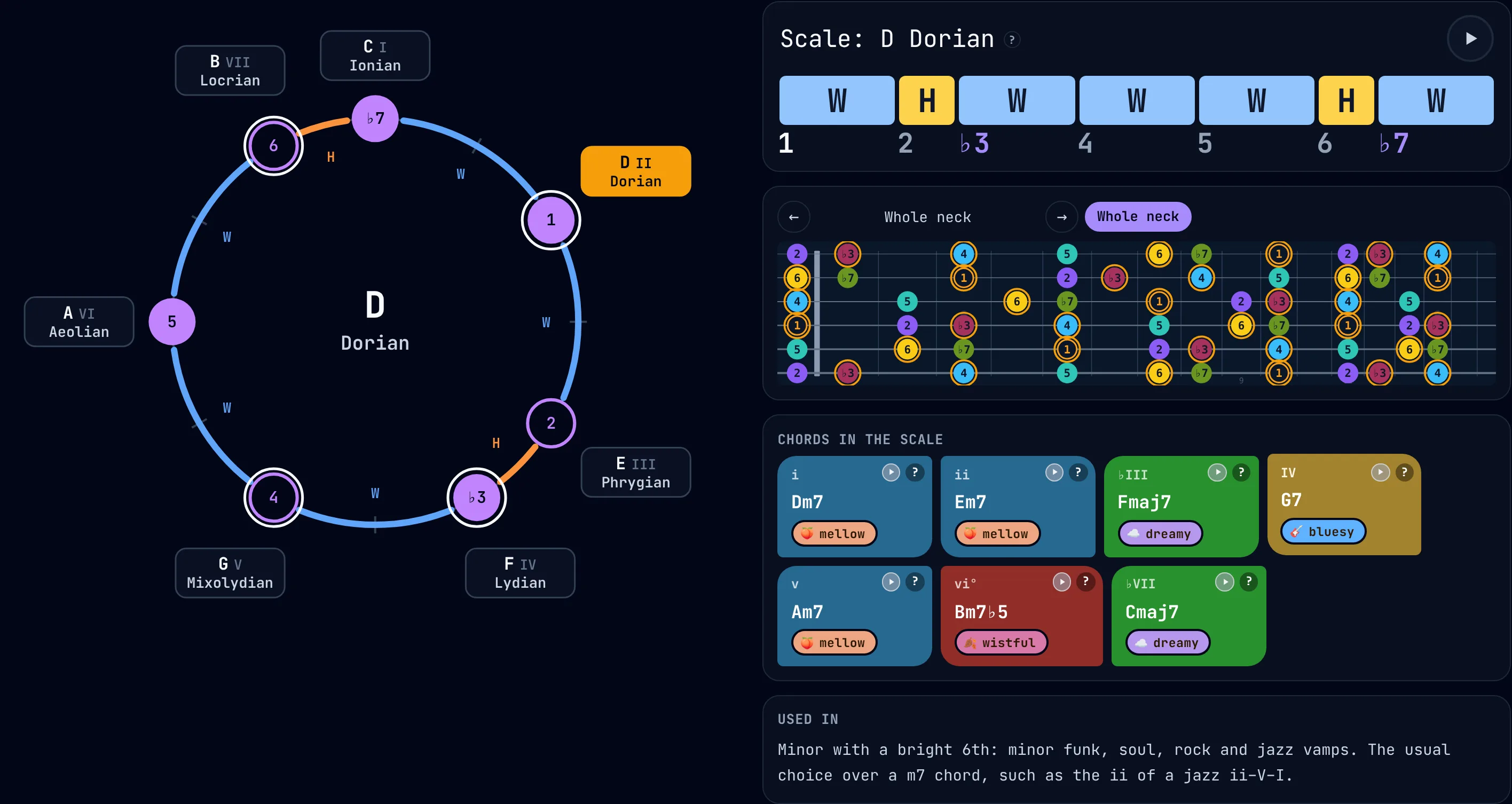
Harmonic minor, melodic minor and their modes
Natural minor has no leading note, so its V chord is minor and pulls home weakly. Raise the 7th and you get harmonic minor, with a strong V7 and the exotic 1½ step between ♭6 and 7. Raise the 6th as well and you get melodic minor, the scale jazz players mine for its modes.
Each family has its own circle of modes. Phrygian dominant, the 5th mode of harmonic minor, is the sound of flamenco and metal and the scale over the V7 of a minor key. Lydian dominant and the Altered scale, modes of melodic minor, are the sounds over a 7♯11 and a 7alt chord.
Open E Phrygian dominant →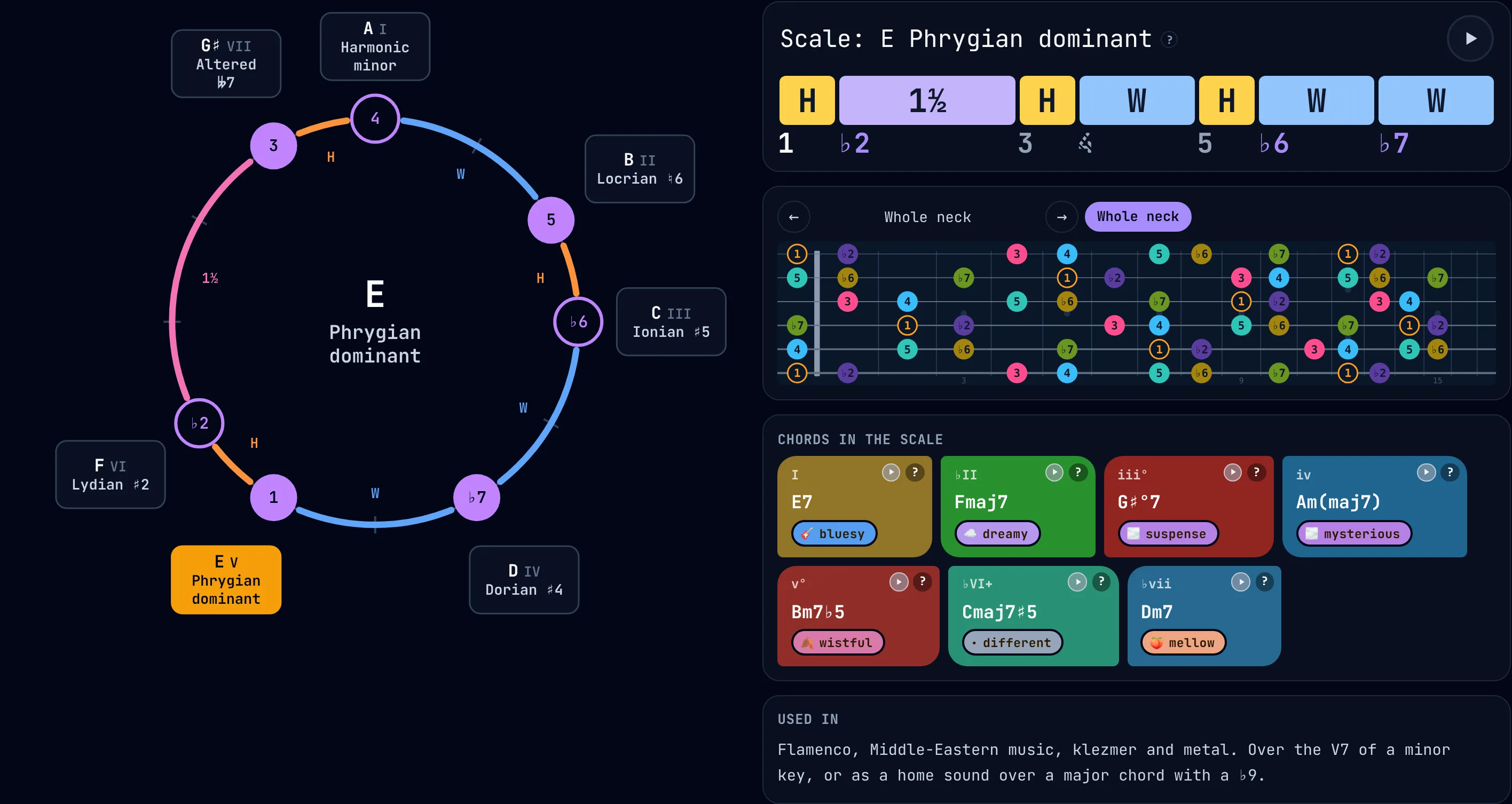
Pentatonic and blues: five notes, every style
The minor pentatonic is the first scale most guitarists learn, and for good reason: five notes, no half steps, nothing that clashes. Its circle shows its relative, the major pentatonic, which uses the same notes from a different root: A minor pentatonic and C major pentatonic are one shape.
The blues scales add one note each: the ♭5 of the minor blues and the ♭3 of the major blues, the notes that give the blues its bite.
Open A minor pentatonic →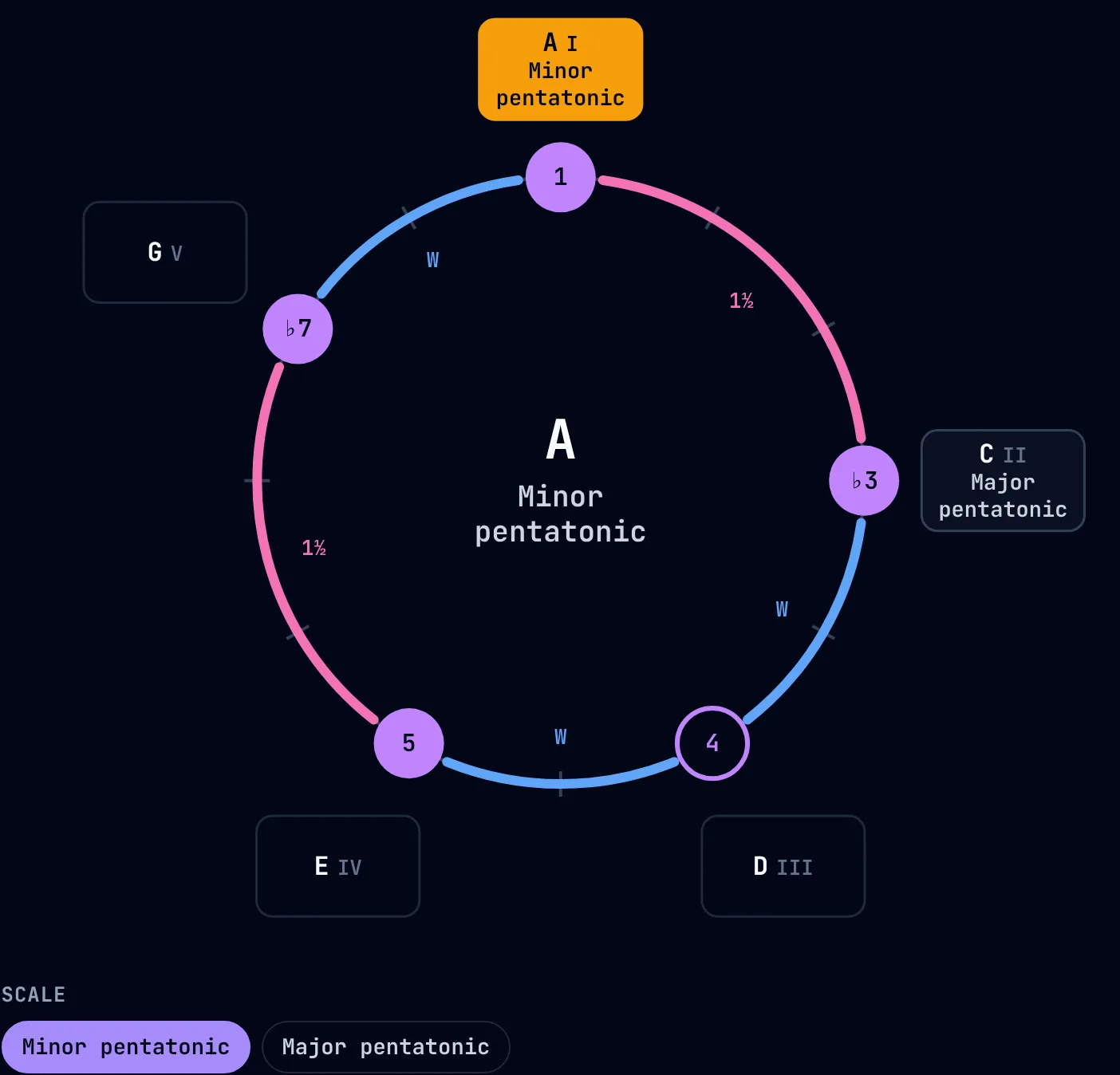
Diminished, whole-tone and augmented scales
Symmetric scales repeat inside the octave, which makes them easy to play and unmistakable to hear. The diminished scale alternates half and whole steps and repeats every three frets, so it has only two modes: half-whole over a 7♭9 chord, whole-half over a diminished 7th. The whole-tone scale, all whole steps, repeats every two frets and has one.
Open C half-whole diminished →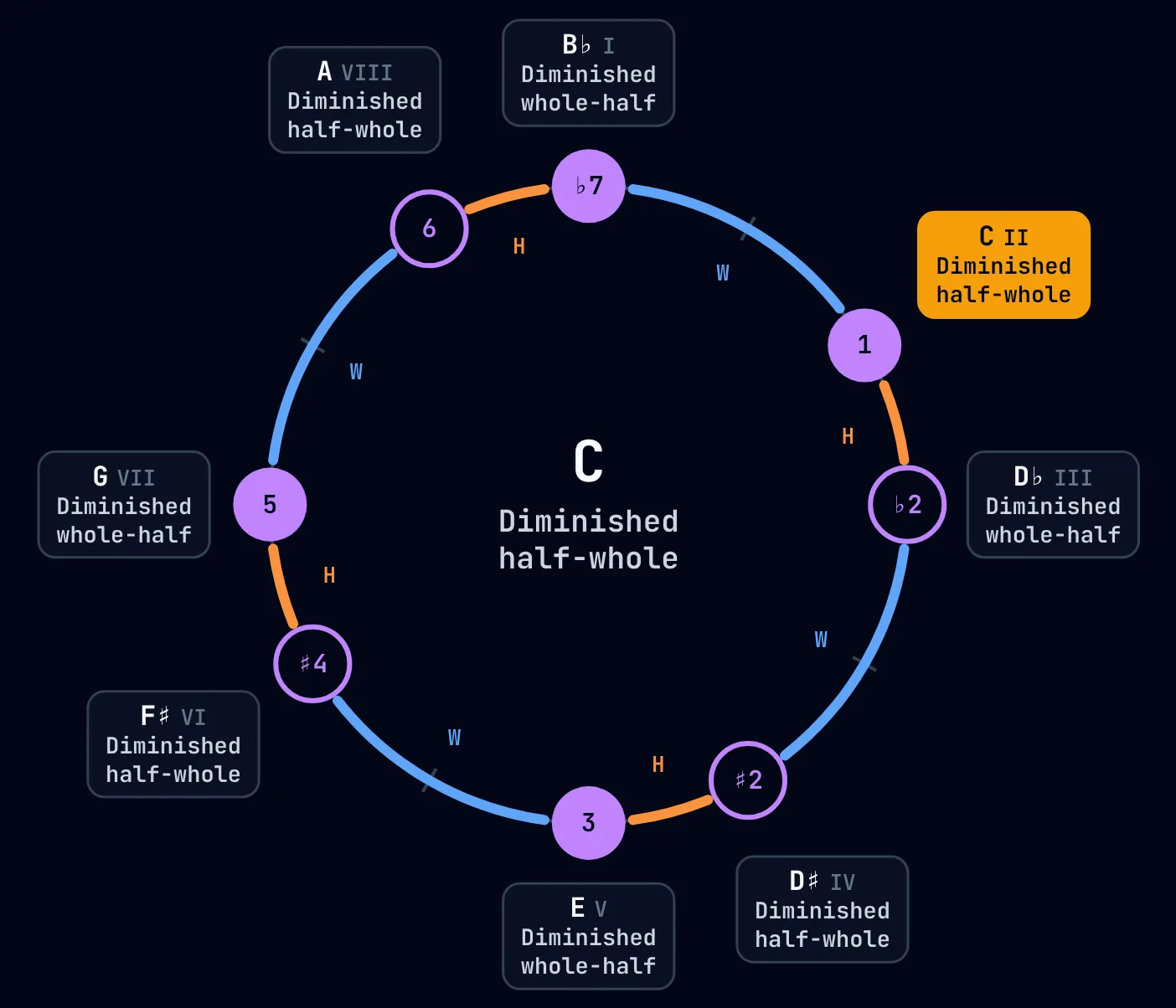
Exotic scales from Hungary to Japan
For the sounds outside Western major and minor: Hungarian minor and the double harmonic with their two 1½ steps, the Neapolitan scales, the Persian scale, the Japanese Hirajoshi and In-sen, the Enigmatic scale, and bebop dominant, the eight-note scale that lands chord tones on the beat.
Open A Hungarian minor →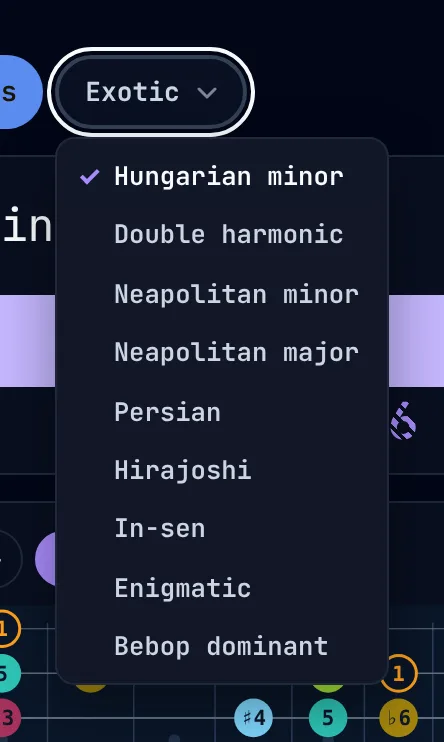
Every scale formula, spelled in C
All 46 scales in the library, family by family, with their formula, steps and notes in C. Each one opens in the library, and every scale on every root, with a printable PDF, is one click away.
Pentatonic & blues
| Scale | Formula | Steps | Notes in C |
|---|---|---|---|
| Minor pentatonic | 1 ♭3 4 5 ♭7 | 1½ W W 1½ W | C E♭ F G B♭ |
| Major pentatonic | 1 2 3 5 6 | W W 1½ W 1½ | C D E G A |
| Minor blues | 1 ♭3 4 ♭5 5 ♭7 | 1½ W H H 1½ W | C E♭ F G♭ G B♭ |
| Major blues | 1 2 ♭3 3 5 6 | W H H 1½ W 1½ | C D E♭ E G A |
Major
| Scale | Formula | Steps | Notes in C |
|---|---|---|---|
| IonianMajor | 1 2 3 4 5 6 7 | W W H W W W H | C D E F G A B |
| Dorian | 1 2 ♭3 4 5 6 ♭7 | W H W W W H W | C D E♭ F G A B♭ |
| Phrygian | 1 ♭2 ♭3 4 5 ♭6 ♭7 | H W W W H W W | C D♭ E♭ F G A♭ B♭ |
| Lydian | 1 2 3 ♯4 5 6 7 | W W W H W W H | C D E F♯ G A B |
| Mixolydian | 1 2 3 4 5 6 ♭7 | W W H W W H W | C D E F G A B♭ |
| AeolianNatural minor | 1 2 ♭3 4 5 ♭6 ♭7 | W H W W H W W | C D E♭ F G A♭ B♭ |
| Locrian | 1 ♭2 ♭3 4 ♭5 ♭6 ♭7 | H W W H W W W | C D♭ E♭ F G♭ A♭ B♭ |
Melodic minor
| Scale | Formula | Steps | Notes in C |
|---|---|---|---|
| Melodic minor | 1 2 ♭3 4 5 6 7 | W H W W W W H | C D E♭ F G A B |
| Dorian ♭2 | 1 ♭2 ♭3 4 5 6 ♭7 | H W W W W H W | C D♭ E♭ F G A B♭ |
| Lydian augmented | 1 2 3 ♯4 ♯5 6 7 | W W W W H W H | C D E F♯ G♯ A B |
| Lydian dominant | 1 2 3 ♯4 5 6 ♭7 | W W W H W H W | C D E F♯ G A B♭ |
| Mixolydian ♭6 | 1 2 3 4 5 ♭6 ♭7 | W W H W H W W | C D E F G A♭ B♭ |
| Locrian ♮2 | 1 2 ♭3 4 ♭5 ♭6 ♭7 | W H W H W W W | C D E♭ F G♭ A♭ B♭ |
| Altered | 1 ♭2 ♭3 ♭4 ♭5 ♭6 ♭7 | H W H W W W W | C D♭ E♭ F♭ G♭ A♭ B♭ |
Harmonic minor
| Scale | Formula | Steps | Notes in C |
|---|---|---|---|
| Harmonic minor | 1 2 ♭3 4 5 ♭6 7 | W H W W H 1½ H | C D E♭ F G A♭ B |
| Locrian ♮6 | 1 ♭2 ♭3 4 ♭5 6 ♭7 | H W W H 1½ H W | C D♭ E♭ F G♭ A B♭ |
| Ionian ♯5 | 1 2 3 4 ♯5 6 7 | W W H 1½ H W H | C D E F G♯ A B |
| Dorian ♯4Ukrainian Dorian | 1 2 ♭3 ♯4 5 6 ♭7 | W H 1½ H W H W | C D E♭ F♯ G A B♭ |
| Phrygian dominant | 1 ♭2 3 4 5 ♭6 ♭7 | H 1½ H W H W W | C D♭ E F G A♭ B♭ |
| Lydian ♯2 | 1 ♯2 3 ♯4 5 6 7 | 1½ H W H W W H | C D♯ E F♯ G A B |
| Altered 𝄫7 | 1 ♭2 ♭3 ♭4 ♭5 ♭6 𝄫7 | H W H W W H 1½ | C D♭ E♭ F♭ G♭ A♭ B𝄫 |
Harmonic major
| Scale | Formula | Steps | Notes in C |
|---|---|---|---|
| Harmonic major | 1 2 3 4 5 ♭6 7 | W W H W H 1½ H | C D E F G A♭ B |
| Dorian ♭5 | 1 2 ♭3 4 ♭5 6 ♭7 | W H W H 1½ H W | C D E♭ F G♭ A B♭ |
| Phrygian ♭4 | 1 ♭2 ♭3 ♭4 5 ♭6 ♭7 | H W H 1½ H W W | C D♭ E♭ F♭ G A♭ B♭ |
| Lydian ♭3 | 1 2 ♭3 ♯4 5 6 7 | W H 1½ H W W H | C D E♭ F♯ G A B |
| Mixolydian ♭2 | 1 ♭2 3 4 5 6 ♭7 | H 1½ H W W H W | C D♭ E F G A B♭ |
| Lydian augmented ♯2 | 1 ♯2 3 ♯4 ♯5 6 7 | 1½ H W W H W H | C D♯ E F♯ G♯ A B |
| Locrian 𝄫7 | 1 ♭2 ♭3 4 ♭5 ♭6 𝄫7 | H W W H W H 1½ | C D♭ E♭ F G♭ A♭ B𝄫 |
Diminished
| Scale | Formula | Steps | Notes in C |
|---|---|---|---|
| Diminished whole-half | 1 2 ♭3 4 ♭5 ♭6 6 7 | W H W H W H W H | C D E♭ F G♭ A♭ A B |
| Diminished half-whole | 1 ♭2 ♯2 3 ♯4 5 6 ♭7 | H W H W H W H W | C D♭ D♯ E F♯ G A B♭ |
Whole tone
| Scale | Formula | Steps | Notes in C |
|---|---|---|---|
| Whole tone | 1 2 3 ♯4 ♯5 ♭7 | W W W W W W | C D E F♯ G♯ B♭ |
Augmented
| Scale | Formula | Steps | Notes in C |
|---|---|---|---|
| Augmented | 1 ♯2 3 5 ♯5 7 | 1½ H 1½ H 1½ H | C D♯ E G G♯ B |
| Augmented inverse | 1 ♭2 3 4 ♯5 6 | H 1½ H 1½ H 1½ | C D♭ E F G♯ A |
Exotic
| Scale | Formula | Steps | Notes in C |
|---|---|---|---|
| Hungarian minor | 1 2 ♭3 ♯4 5 ♭6 7 | W H 1½ H H 1½ H | C D E♭ F♯ G A♭ B |
| Double harmonic | 1 ♭2 3 4 5 ♭6 7 | H 1½ H W H 1½ H | C D♭ E F G A♭ B |
| Neapolitan minor | 1 ♭2 ♭3 4 5 ♭6 7 | H W W W H 1½ H | C D♭ E♭ F G A♭ B |
| Neapolitan major | 1 ♭2 ♭3 4 5 6 7 | H W W W W W H | C D♭ E♭ F G A B |
| Persian | 1 ♭2 3 4 ♭5 ♭6 7 | H 1½ H H W 1½ H | C D♭ E F G♭ A♭ B |
| Hirajoshi | 1 2 ♭3 5 ♭6 | W H 4 H 4 | C D E♭ G A♭ |
| In-sen | 1 ♭2 4 5 ♭7 | H 4 W 1½ W | C D♭ F G B♭ |
| Enigmatic | 1 ♭2 3 ♯4 ♯5 ♯6 7 | H 1½ W W W H H | C D♭ E F♯ G♯ A♯ B |
| Bebop dominant | 1 2 3 4 5 6 ♭7 7 | W W H W W H H H | C D E F G A B♭ B |
Frequently asked questions
Is the scale library free?
Yes. It is free, runs in your browser and needs no account. Every scale, every mode and every key is available.
What is a mode?
A mode is a scale played from one of its own notes. Play the notes of C major from D to D and you get D Dorian: the same seven notes, but a different note feels like home, so the pattern of whole and half steps, and the sound, changes. The scale library draws the parent scale as a circle so you can see every mode at once.
What is the difference between Dorian and natural minor?
One note: the 6th. Natural minor (Aeolian) has a ♭6, Dorian a natural 6, which gives it a brighter, funkier minor sound. That 6th is the 3rd of the IV chord, which is why Dorian vamps often move between a minor i and a major IV, such as Dm7 to G7.
Which scale should I play over a chord?
Start from the chord’s family: Dorian over a m7, Mixolydian over a dominant 7, Ionian or Lydian over a maj7, Locrian over a m7♭5, and Phrygian dominant over the V7 of a minor key. The minor pentatonic works over all three chords of a blues. The chord progression builder suggests a scale for every chord of a song.
What do W, H and 1½ mean in a scale formula?
They are the gaps between neighbouring notes: W is a whole step (two frets), H a half step (one fret), and 1½ a step and a half (three frets), as in the pentatonic and harmonic minor scales. Every major scale is W W H W W W H.
How many positions does a scale have on the guitar?
Five, one for each CAGED shape, each spanning about four or five frets; together they cover the whole neck. The scale library steps through them one by one, and shows the whole neck at once when you want the full map.
Why does the diminished scale have only two modes?
It is symmetric: it repeats every three frets, so starting it from any other note gives back one of just two patterns, whole-half or half-whole. The whole-tone scale repeats every two frets and has only one.
Which chords are in a scale?
Stack every other note of the scale from each of its notes and you get its chords. In D Dorian those are Dm7, Em7, Fmaj7, G7, Am7, Bm7♭5 and Cmaj7. The scale library lists them with their Roman numerals and lights up each chord’s notes on the neck when you click it.
Find your next scale
Start with a scale you know, then turn the circle one step and hear what changes.