Interactive Guitar Chord LibraryEvery chord, built from a triad
Pick any chord, from a plain major triad to an altered 13th or a slash chord, and see how it is put together: its formula, the triad at its heart, what every extra note does on the guitar, and every CAGED voicing on the fretboard, in all 12 keys.
Works on desktop, tablet and phone. Nothing to install.
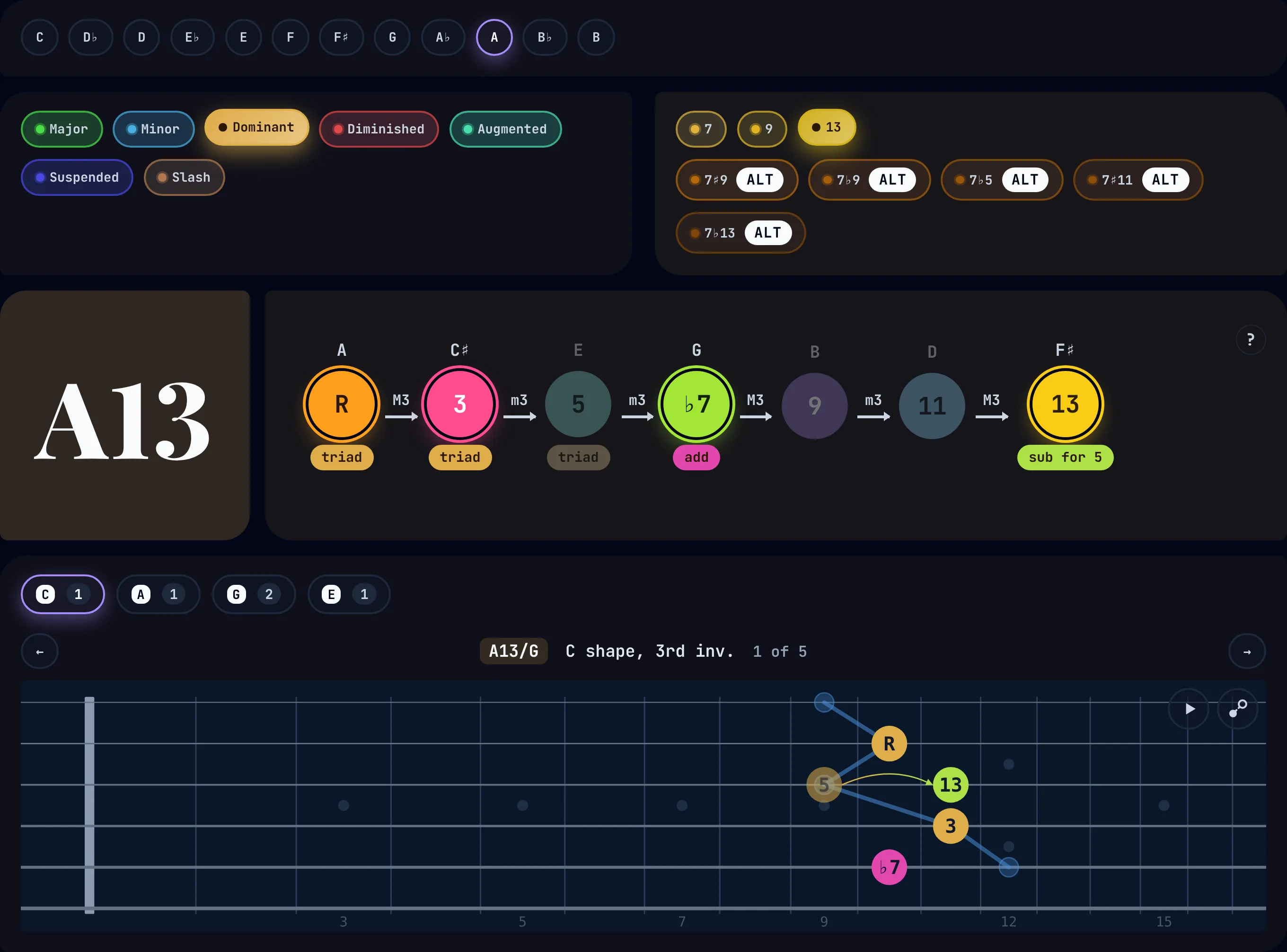
- The triad insideEvery chord shown as a triad plus the notes that colour it.
- What each note doesKept, added, or taking a triad note's string, with an arrow to show where.
- Every voicingAll five CAGED shapes and every inversion, named and playable.
- Hear itEach voicing strummed, with octave doublings for a fuller sound.
Every chord is a triad with something added
A triad is three notes stacked in thirds: a root, a 3rd and a 5th. The two thirds decide the chord's character. Add another third on top and you have a 7th chord; keep going and you reach the 9th, 11th and 13th. However rich a chord sounds, a triad is holding it up, which is why players who know their triads find new chords so quickly.
| Triad | Thirds | Formula | In C |
|---|---|---|---|
| Major | M3 + m3 | 1 3 5 | C E G |
| Minor | m3 + M3 | 1 ♭3 5 | C E♭ G |
| Diminished | m3 + m3 | 1 ♭3 ♭5 | C E♭ G♭ |
| Augmented | M3 + M3 | 1 3 ♯5 | C E G♯ |
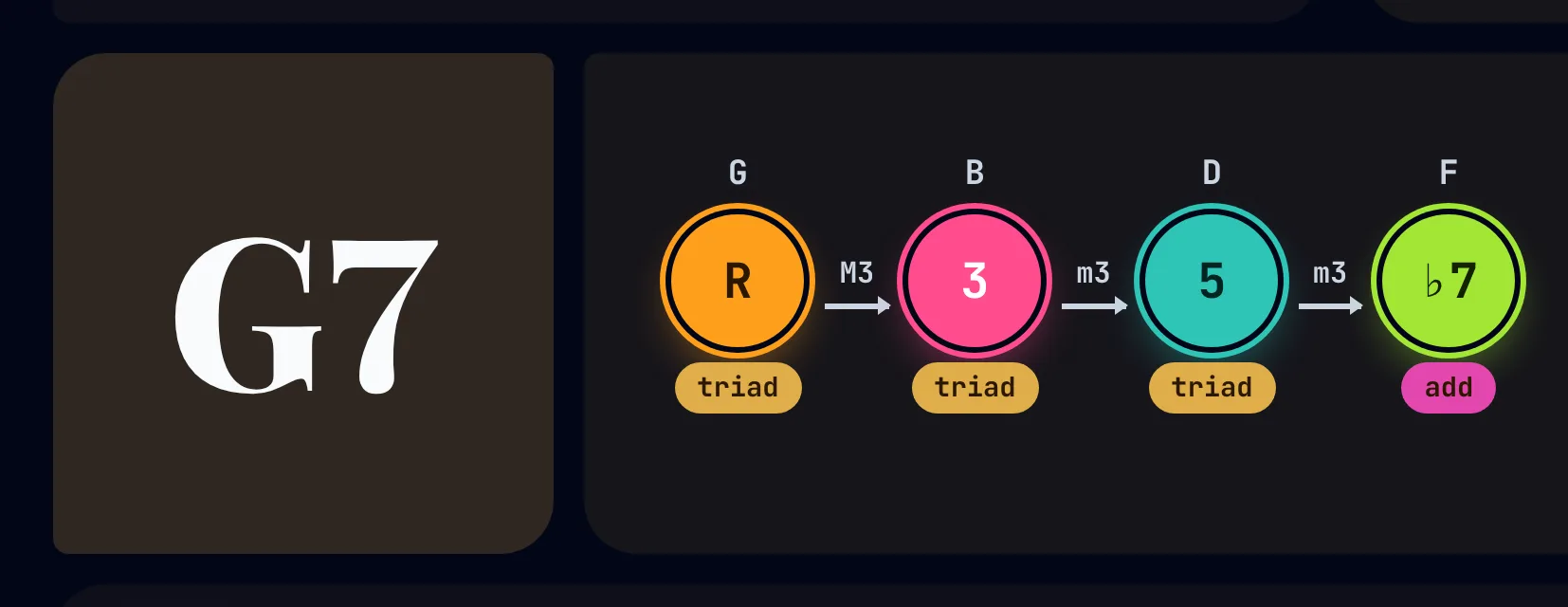
- The triad: G, B and D, the three notes G7 is built on.
- The step up from each note to the next: a major 3rd, then two minor 3rds.
- The ♭7, F, stacked a minor 3rd above the 5th, turns G major into G7.
The rules of chord construction
Ten rules cover every chord in a chord book. The library follows all of them, so you can watch each one at work on any chord you pick.
Start from a triad
Root, 3rd and 5th, stacked in thirds. The 3rd makes it major or minor; the 5th makes it diminished or augmented when it moves.
A third on top makes a 7th chord
A major 7th over a major triad is maj7, a ♭7 is a dominant 7. Over minor you get m7 or m(maj7); over diminished, m7♭5 or the °7 with its ♭♭7.
Keep stacking for extensions
The 9th, 11th and 13th are the 2nd, 4th and 6th an octave up. Each one sits on the stack below it: a 9th chord holds a 7th, a 13th holds the 9th and 11th in theory.
No 7th, no stack
6, add9, add11 and 6/9 are a triad with a colour note, not a stack. Cadd9 has no 7th, which is what makes it sound open rather than jazzy.
Sus chords replace the 3rd
A 2nd or a 4th takes the 3rd's place, so the chord is neither major nor minor and wants to resolve. 7sus4 keeps the ♭7 for a dominant without its 3rd.
On guitar, something has to give
Each extension takes the string of a triad note that matters less, usually the 5th, or gets a string of its own. The root and 3rd stay: they say what the chord is.
Leave out what clashes
A natural 11th a minor 9th above a major 3rd sounds wrong, so major and dominant chords use a ♯11, and a 13th chord leaves the 11th out.
The root can move down
When an extension needs the root's string, the root can drop to the string below the triad: an anchored voicing keeps the bass and frees a string on top.
A slash names the bass
Chord/bass puts any note under a triad. A chord tone gives an inversion, such as C/E; another note gives a new chord: G/F is G7 with the 7th in the bass.
Alter a dominant for tension
Raise or lower the 5th or the 9th, or add a ♯11 or ♭13, and a dominant 7th pulls harder towards the next chord: G7♯9, G7♭9, G7♭13.
9ths, 11ths and 13ths: which triad note makes room
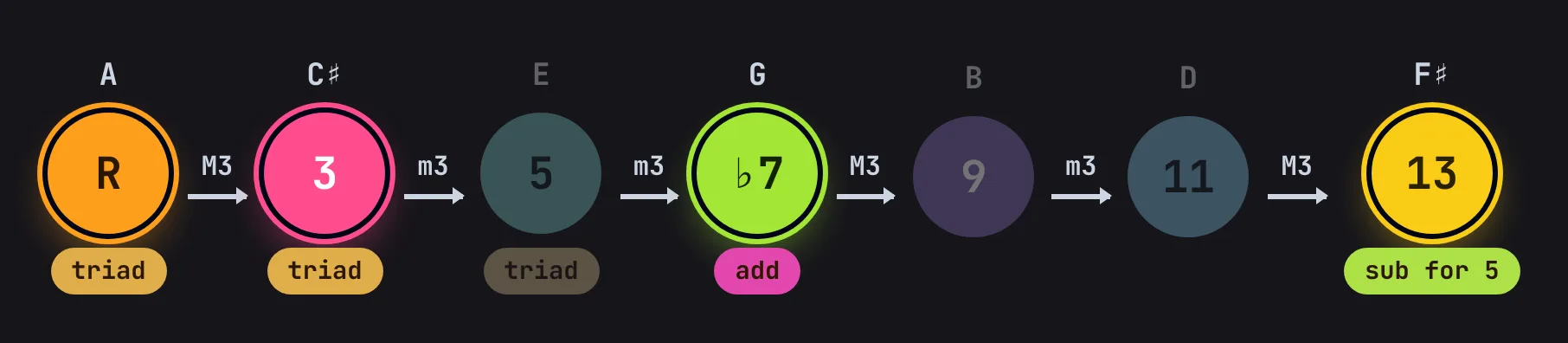
A 13th chord has seven notes and a guitar has six strings and four fingers, so a playable 13th is a choice. The library shows the choice tone by tone. In A13 the root, 3rd and ♭7 stay, the 13th takes the 5th's string, and the 9th and 11th are left out, because the sound of the chord is all in those four notes.
- The 5th, E, gives its string away.
- The 9th and 11th are part of the stack but not played: no finger, and no need.
- The 13th, F♯, plays on the 5th's string instead.
See the move on the neck
On the fretboard the triad shape stays drawn, and an arrow runs from the triad note to the extension that replaces it. You see the voicing as what it is: a triad shape you already know, with one finger moved.
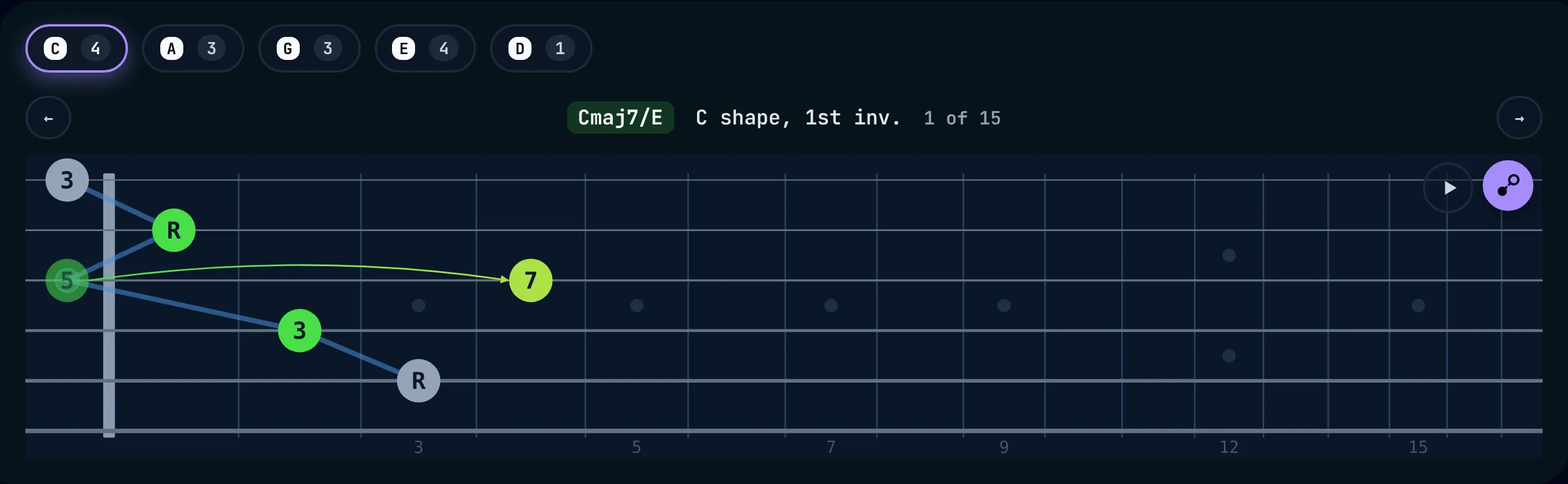
- The five CAGED shapes, with the number of voicings in each.
- The voicing's name: shape, inversion, and its bass after the slash.
- Play the chord, strummed low to high.
The same happens in Cmaj7, where the major 7th, B, takes the open G string of the C shape: the move from C to Cmaj7 is one finger.
Open Cmaj7 →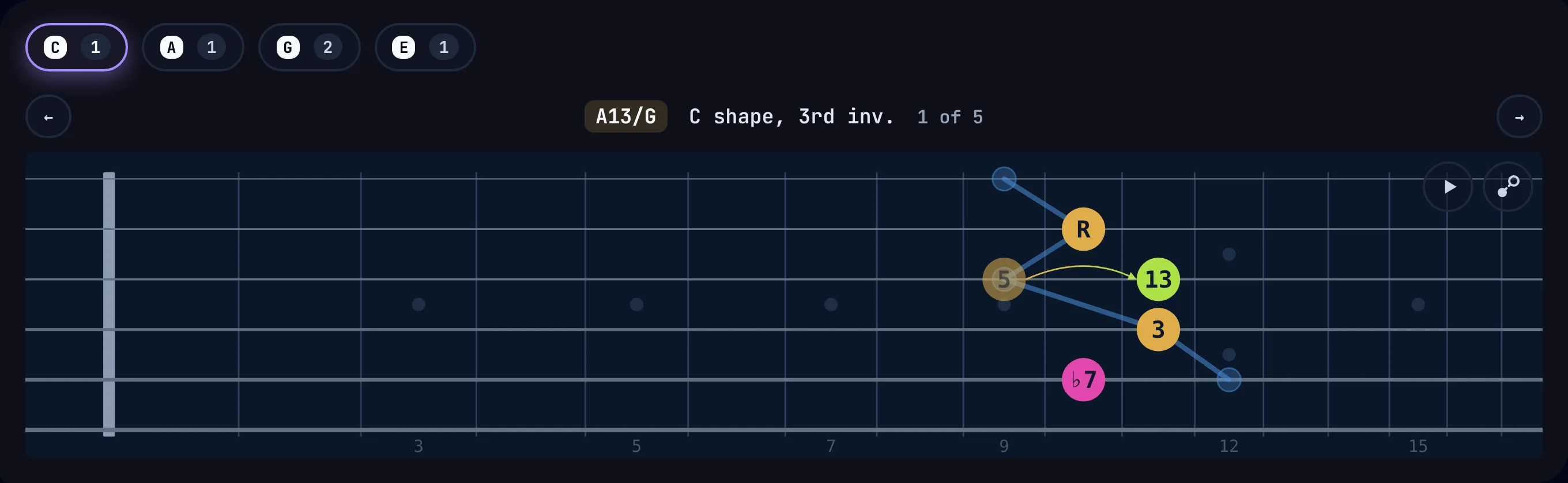
When the root moves to the string below
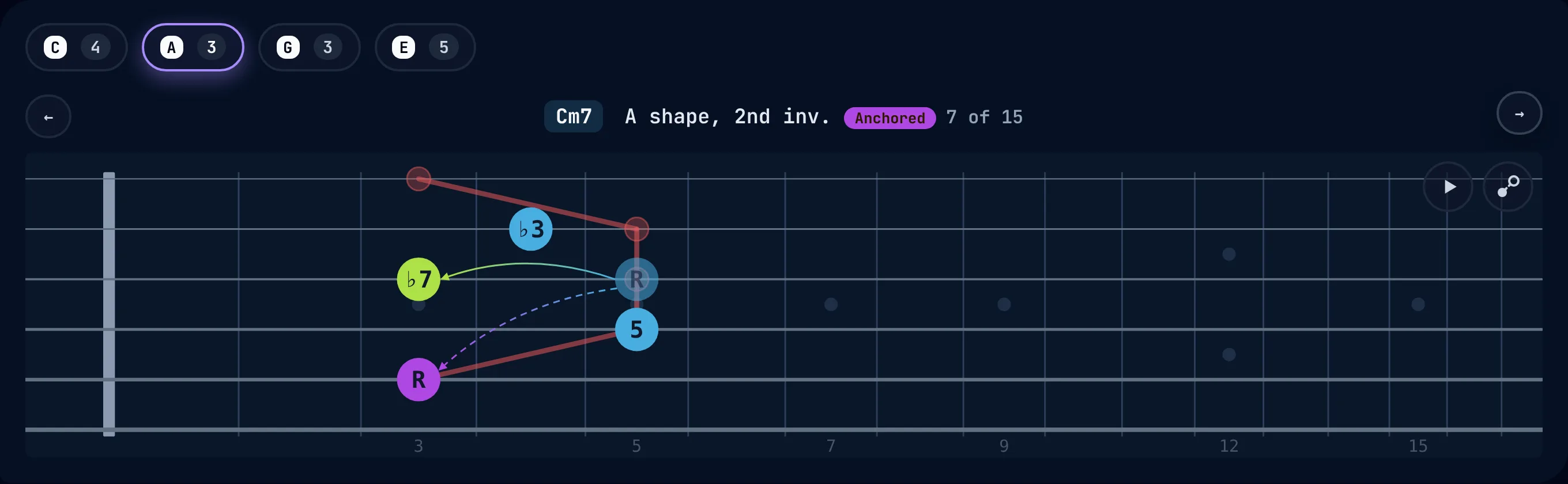
Sometimes the note that has to make room is the root itself. Rather than lose it, the library moves it down to the string below the triad. In this Cm7 the ♭7 takes the root's string inside the A shape, and the root drops to the 5th string, where it becomes the bass.
- Voicings that move the root are tagged Anchored, and listed apart in each CAGED shape.
Slash chords: a triad over a new bass
A slash chord keeps a triad on top and changes only the bass. The library reads it bass first, then the triad, so you see both what you play and what the whole chord spells. G/F is a G major triad over F: together G, B, D and F, a G7 with its 7th in the bass, the sound of a bass line walking down under a held chord.
- The bass note, played below the whole triad.
The slash family holds major and minor triads over the 2nd, the ♭7 and the 7, in every key: G/A, G/F, G/F♯, Gm/A, Gm/F and Gm/F♯ in G.
Open G/F →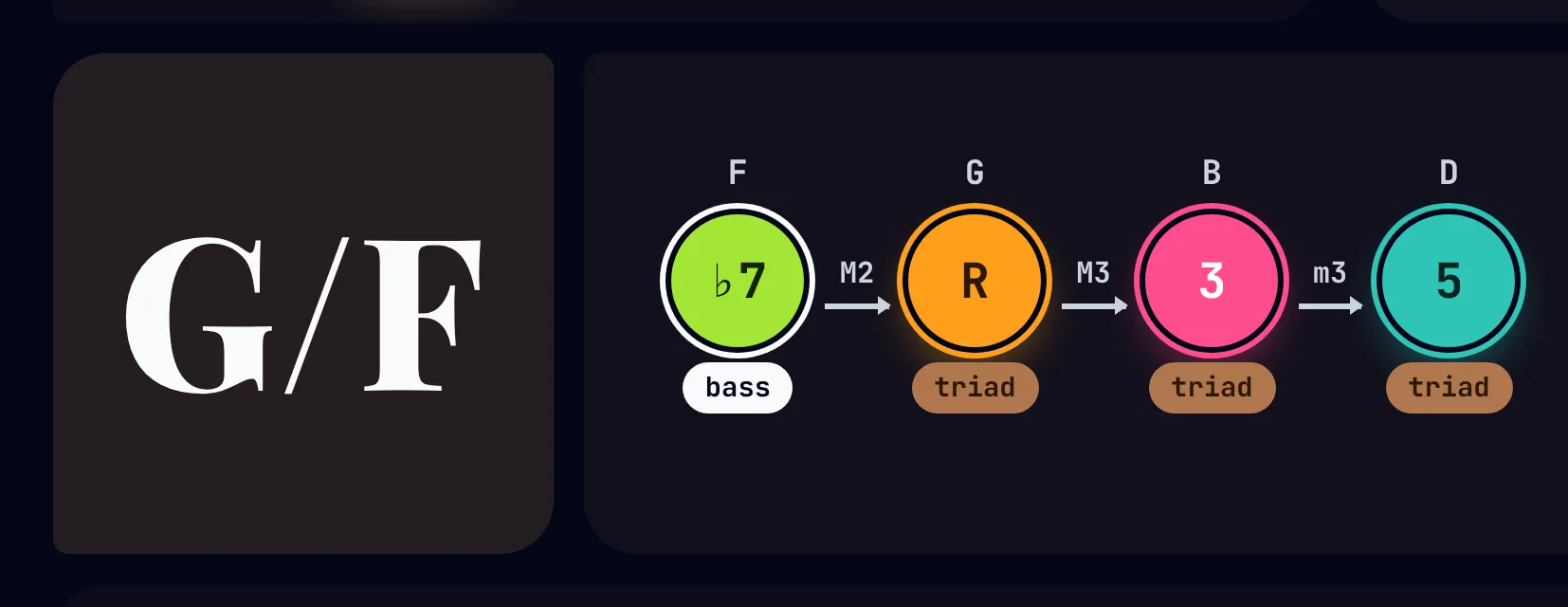
Seven chord families, from major to altered
Chords are grouped the way you think of them: major, minor, dominant, diminished, augmented, suspended and slash. Inside each family the chords go from plain to rich, and altered dominants come last, tagged ALT.
- The family: here dominant, the chords with a major 3rd and a ♭7.
- Altered dominants: 7♯9, the Hendrix chord; 7♭9, the sound of a minor-key V; 7♭5, 7♯11 and 7♭13.

Chords that do not work, and why
Some chords exist on paper but not on the guitar or to the ear. Emaj11 stacks a natural 11th, A, a minor 9th above the major 3rd, G♯, and the two grind against each other. The library shows the formula, greys it out and says why, so you learn the rule instead of hunting for a shape that does not exist. Reach for Emaj7♯11 instead.
See it for yourself →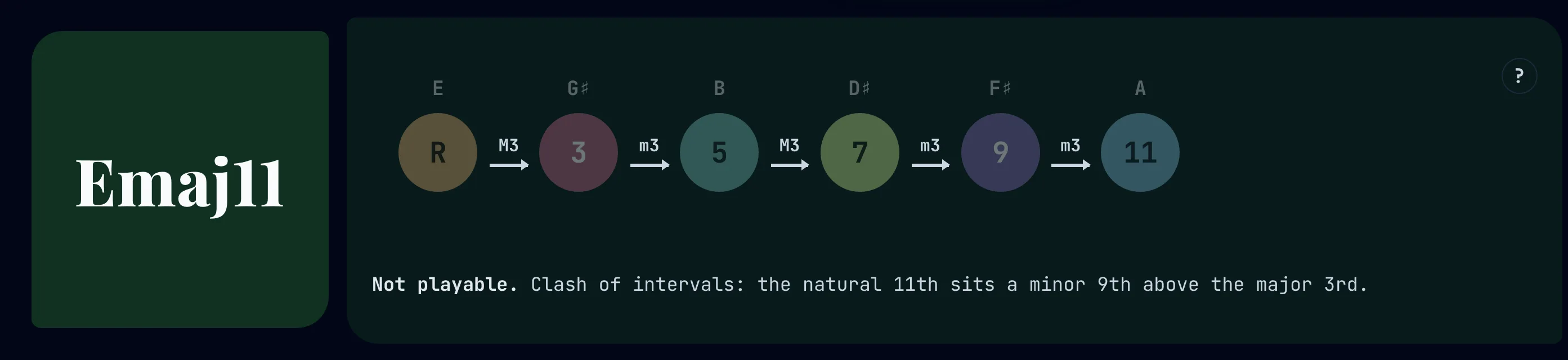
Every voicing, filed by CAGED shape and inversion
Point at a CAGED shape to list its voicings: root position, 1st, 2nd and, for a 7th chord, 3rd inversion, plus the anchored ones. The arrows step through all of them in order up the neck, and the name above the fretboard always gives the shape, the inversion and the bass note.
Octave doublings add the notes you can double for a fuller strum, drawn in grey so the voicing itself stays clear.
The CAGED system explained →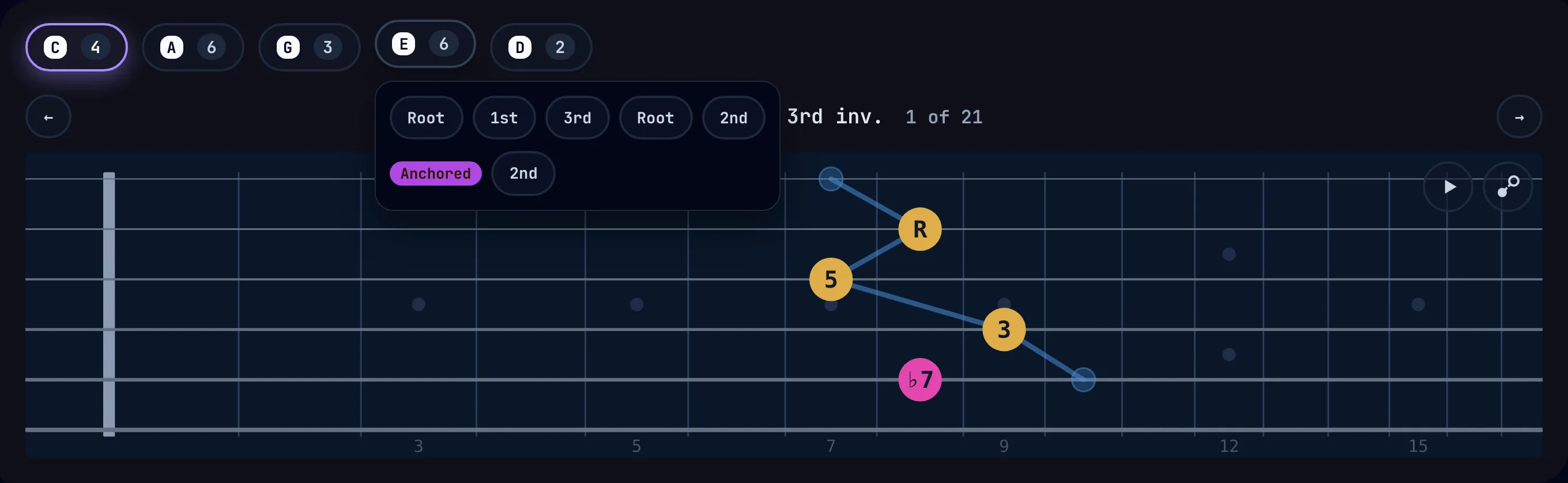
Every chord formula, spelled in C
The formula of every chord in the library, family by family, with its notes in C. Notes in brackets belong to the stack but are left out on guitar. Each chord opens in the library, and every chord in every key, with its voicings and a printable PDF, is one click away.
Major chords
Minor chords
Dominant chords
Diminished chords
Augmented chords
Suspended chords
Frequently asked questions
Is the chord library free?
Yes. It is free, runs in your browser and needs no account or download. Every chord, every key and every voicing is available.
How are chords built from triads?
Every chord starts from a triad: a root, a 3rd and a 5th, stacked in thirds. Keep stacking thirds and you get the 7th, then the 9th, 11th and 13th. On guitar, each of those extra notes either takes the string of a triad note that matters less, usually the 5th, or gets a string of its own. The chord library shows which, for every voicing.
What is a chord formula?
The list of intervals a chord is made of, counted up from its root: 1 3 5 for a major triad, 1 ♭3 5 for minor, 1 3 5 ♭7 for a dominant 7th, 1 3 5 ♭7 9 13 for a 13th chord. Apply the formula to any root and you get that chord in that key.
Why does a 13th chord leave out the 9th and 11th?
A 13th chord stacks seven notes, and a guitar chord has four to six fingers and strings to give them. The natural 11th clashes with the major 3rd, a minor 9th apart, so it is left out first; the 9th and the 5th add the least, so they go next. What is left, root, 3rd, ♭7 and 13, still says exactly what the chord is.
What is a slash chord?
A chord with a bass note other than its root, written chord/bass. G/F is a G major triad over an F in the bass, which together spell G7 with its 7th in the bass. Slash chords give a bass line that walks while the chord stays put.
What is an altered dominant chord?
A dominant 7th with a flattened or sharpened 5th or 9th, or a ♯11 or ♭13, such as G7♯9 or G7♭9. The altered note adds tension that pulls hard towards the next chord, which is why they are everywhere in jazz, blues and funk.
Why is Cmaj11 marked as not playable?
Its natural 11th, F, sits a minor 9th above the major 3rd, E, which sounds like a wrong note rather than a colour. Players use Cmaj7♯11 instead, or drop the 3rd and play a sus chord.
Does it show inversions and CAGED shapes?
Yes. Every voicing is filed under one of the five CAGED shapes and named by its inversion: root position, 1st, 2nd or 3rd inversion, with the bass note written after a slash, such as G7/F.
Build your first chord
Pick a chord you know, then add one note to it and see where it goes on the neck.