Interactive Circle of Fifths for GuitarSee how every chord leads to the next
The 12 major keys round the outside, their relative minors inside, and the chords of your key lit up and coloured by what they do. Hover a chord to see how it moves from the one before, which of its notes are outside the key, and which secondary dominant or tritone substitute leads into it.
Works on desktop, tablet and phone. Nothing to install.
- Keys that relateEvery major key and its relative minor, next to the keys that share its notes.
- Chords by roleHome, away and pull-back chords in their own colours, with Roman numerals.
- The moves namedSecondary dominants, tritone subs, backdoor dominants and borrowed chords.
- Modes tooDorian, Mixolydian, harmonic minor and more, with the signature chord ringed.
Twelve keys, each a fifth from the next
Start at the top with C and move clockwise by fifths: G, D, A, E, B, F♯, and on round through D♭, A♭, E♭, B♭ and F back to C. Moving clockwise is moving up a fifth; moving counter-clockwise is moving up a fourth, which is why the same picture is also called the cycle of fourths.
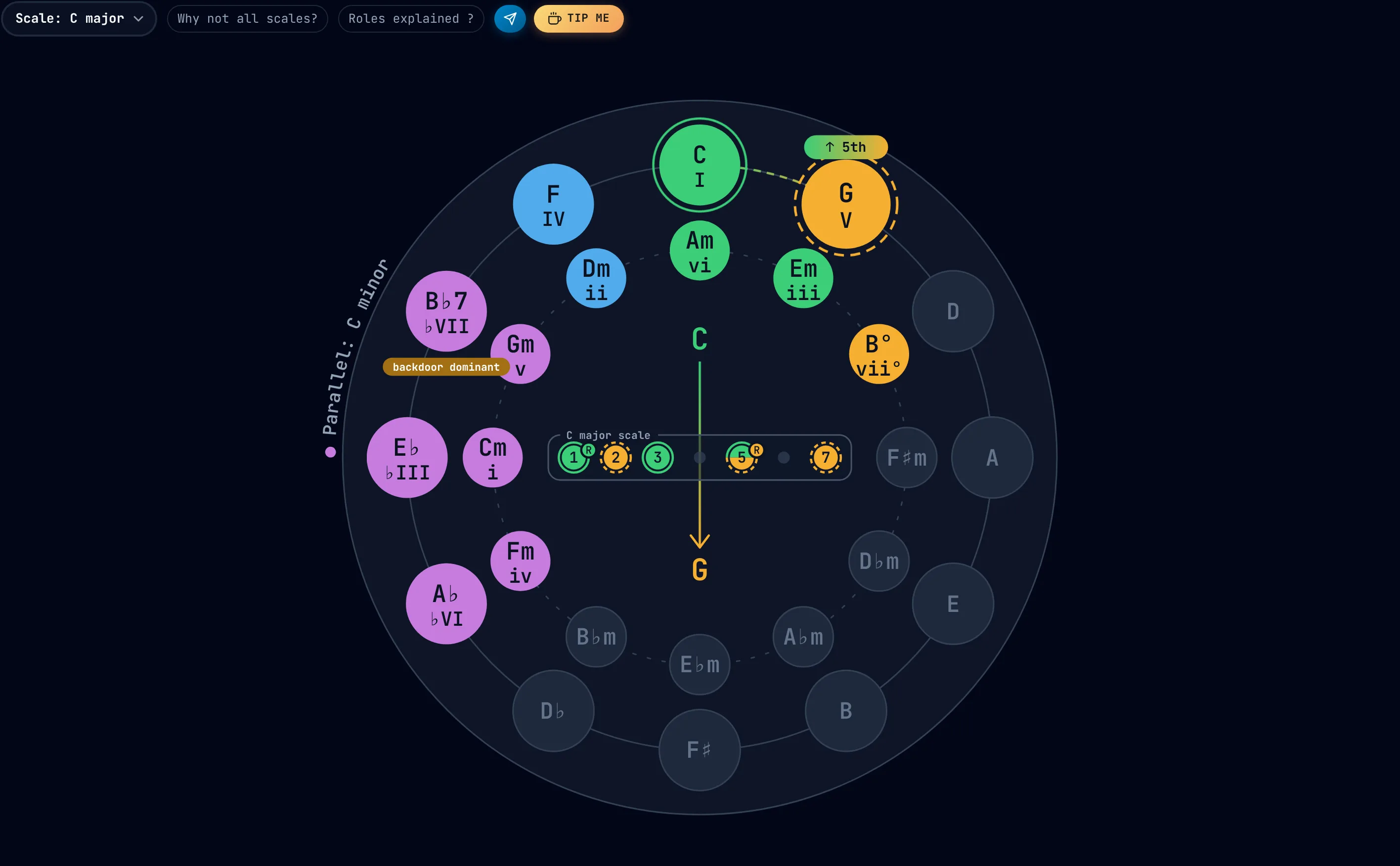
The chords of a key sit together. Home is the key itself; the chord a step clockwise is V, a step counter-clockwise is IV. Under them, on the inner ring, sit the minor chords of the key. Here G is hovered in C major: it is one step clockwise of home, the V chord, and the circle shows the arc it takes from C.
- The chord you hover, here G, the V of C major.
- The key's seven notes as dots: lit for the notes of the chord, so you see it is G, B and D against the C major scale.
- The scale menu: pick a major key or a mode, and the whole circle follows.
How many sharps or flats in every key
One step clockwise adds a sharp; one step counter-clockwise adds a flat. The sharps arrive in the order F♯ C♯ G♯ D♯ A♯ E♯, and the flats in the reverse order: B♭ E♭ A♭ D♭ G♭ C♭. The table gives each key's signature, its relative minor, and the I, IV and V chords you can write most songs in that key with.
| Major key | Relative minor | Signature | I · IV · V |
|---|---|---|---|
| C major | A minor | none | C · F · G |
| G major | E minor | 1 sharp | G · C · D |
| D major | B minor | 2 sharps | D · G · A |
| A major | F♯ minor | 3 sharps | A · D · E |
| E major | C♯ minor | 4 sharps | E · A · B |
| B major | G♯ minor | 5 sharps | B · E · F♯ |
| F♯ / G♭ major | D♯ minor / E♭ minor | 6 sharps / 6 flats | F♯ · B · C♯ or G♭ · C♭ · D♭ |
| D♭ major | B♭ minor | 5 flats | D♭ · G♭ · A♭ |
| A♭ major | F minor | 4 flats | A♭ · D♭ · E♭ |
| E♭ major | C minor | 3 flats | E♭ · A♭ · B♭ |
| B♭ major | G minor | 2 flats | B♭ · E♭ · F |
| F major | D minor | 1 flat | F · B♭ · C |
Home, away and pull-back, in colour
Every chord of a key does one of three jobs. The tonic is home and feels settled; the subdominant lifts away from it; the dominant pulls back with tension that wants to resolve. The circle colours the chords of the key by that job, so a progression reads as a journey: out from green, through blue, and back by amber.
The “Roles explained” button spells the roles out for the key on show: which chords are tonic, subdominant and dominant, which pull home, the typical moves and songs built on them. Change the key or the mode and it rewrites itself.
See the roles in your key →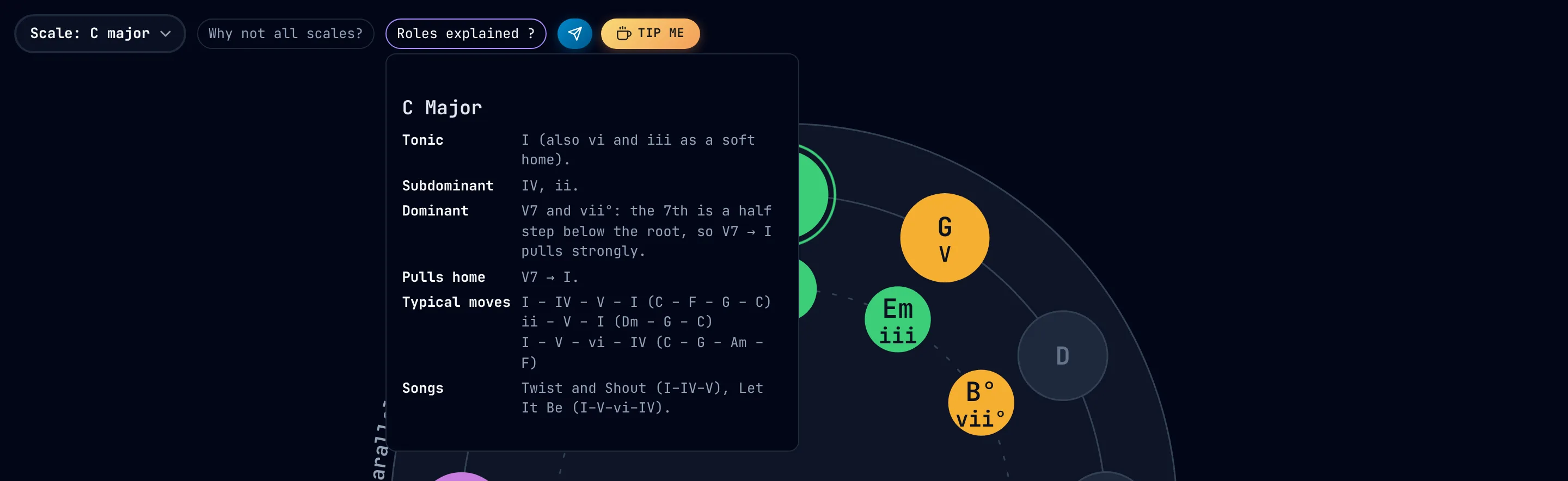
The chords that lead somewhere new
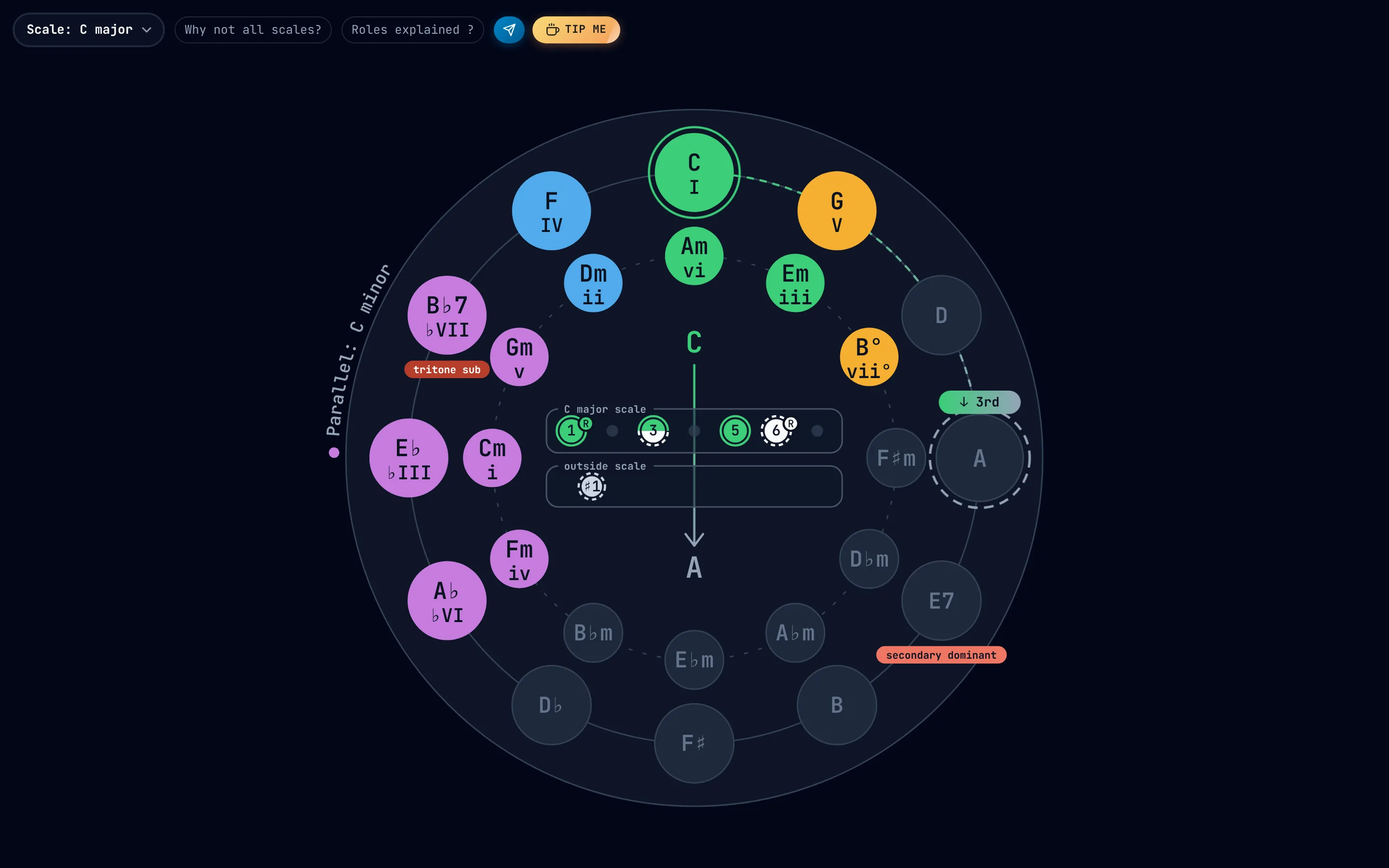
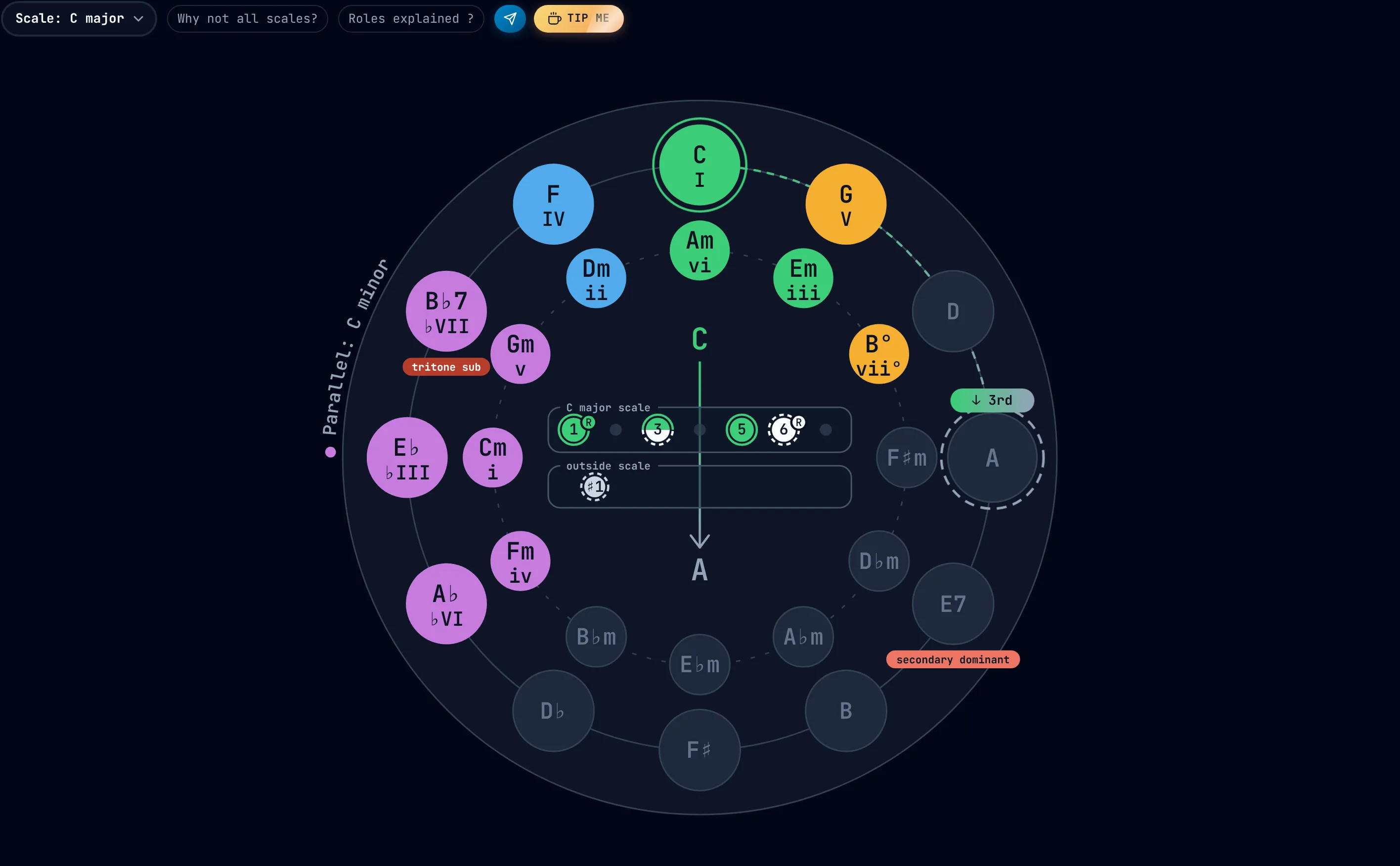
A chord outside the key is not a mistake: it is usually the V7 of a chord that is in it. Hover A in C major and the circle shows E7 as the secondary dominant that leads into it, the V7 of A. Chain the idea and you get E7 → A7 → D7 → G7 → C, each chord a fifth below the one before, running round the circle against the clock.
- The chord you hover, A, which is not in C major.
- The root motion from the chord before: down a third.
- The notes of A against the key: the C♯ is outside C major.
- E7, marked as the secondary dominant: the V7 that leads into A.
- B♭7, its tritone substitution, which shares E7's 3rd and 7th.
The violet chords: borrowed from the parallel key
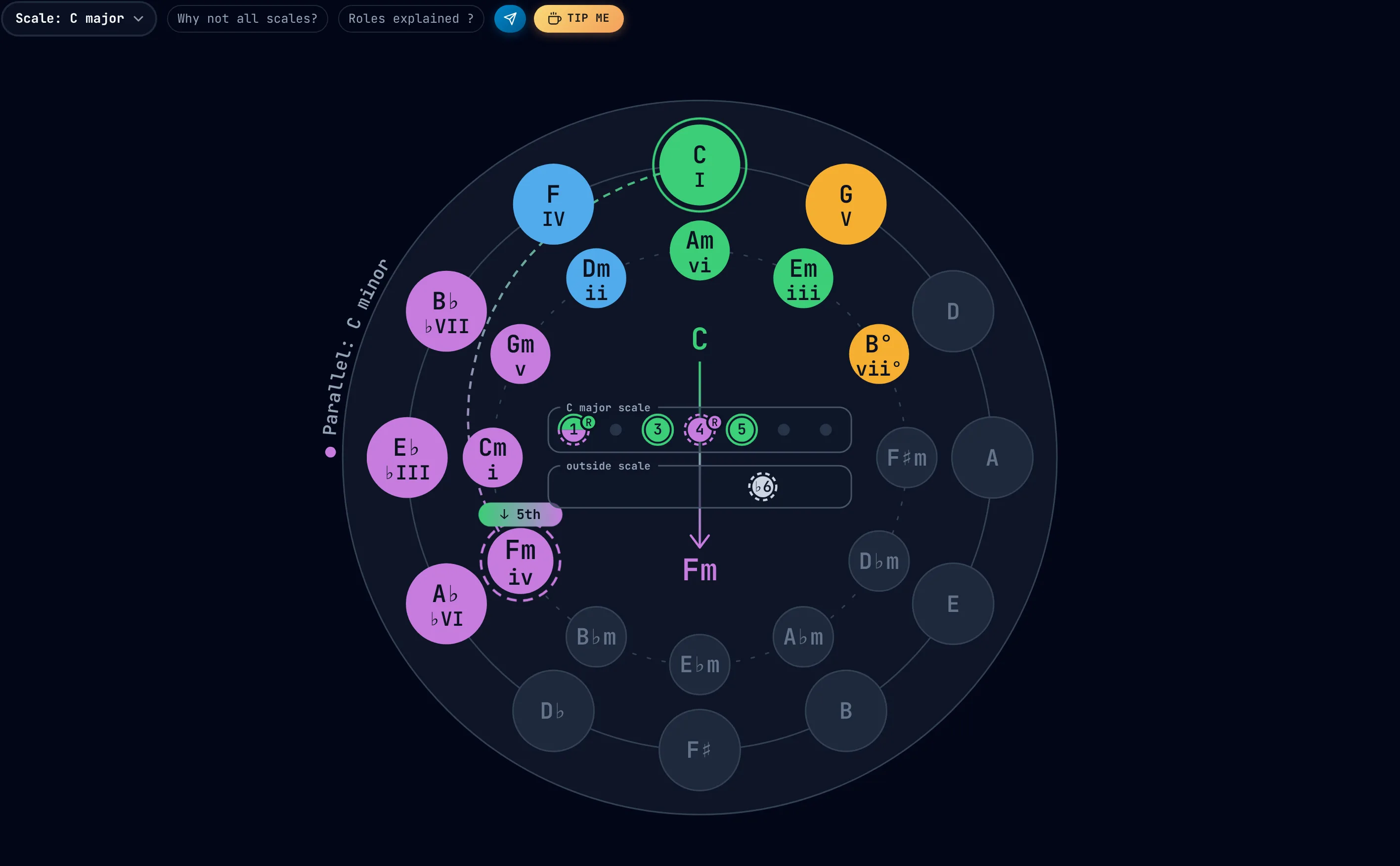
The chords in violet, such as F minor and B♭ in C major, belong to the parallel minor rather than to C major. Borrowing one of them is the oldest trick for adding a darker colour: the IV chord turned minor, or the ♭VII a whole step below home. The legend round the circle names the parallel scale they come from.
- Fm, the minor IV, hovered.
- The parallel scale the violet chords are borrowed from.
- The notes outside the key: the A♭ that gives the chord its colour.
One circle for every mode
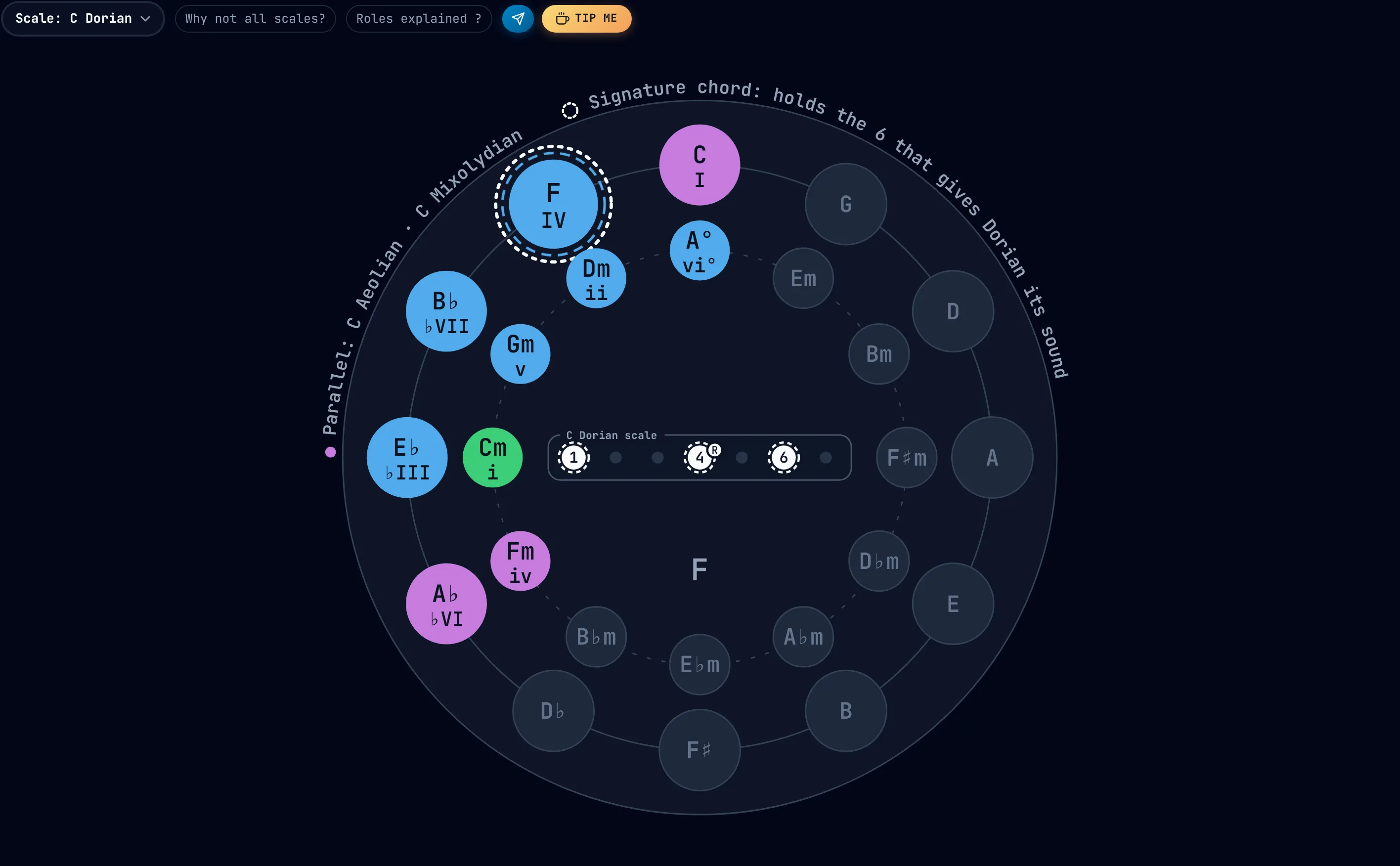
Open the scale menu and the circle changes with it. Pick C Dorian and the circle marks that scale's own chords, and rings the signature chord: the one that holds the note that gives the mode its sound. In Dorian it is the major IV, the chord of the natural 6th that separates Dorian from natural minor.
- The scale menu, set to Dorian.
- The dotted ring on the signature chord, the major IV.
- The legend: which note the signature chord holds, and what it gives the mode.
Click a minor key and the circle turns with it
A relative minor shares every note with the major above it. A minor sits under C major, E minor under G major, and the circle shows it: click Am and home moves there, with C now the III chord and the same chords coloured by their new roles. It is the quickest way to see why a song in A minor and a song in C major can use the same chords.
- The scale menu, now A natural minor.
- C hovered, the ♭III of A minor and the I of its relative major.
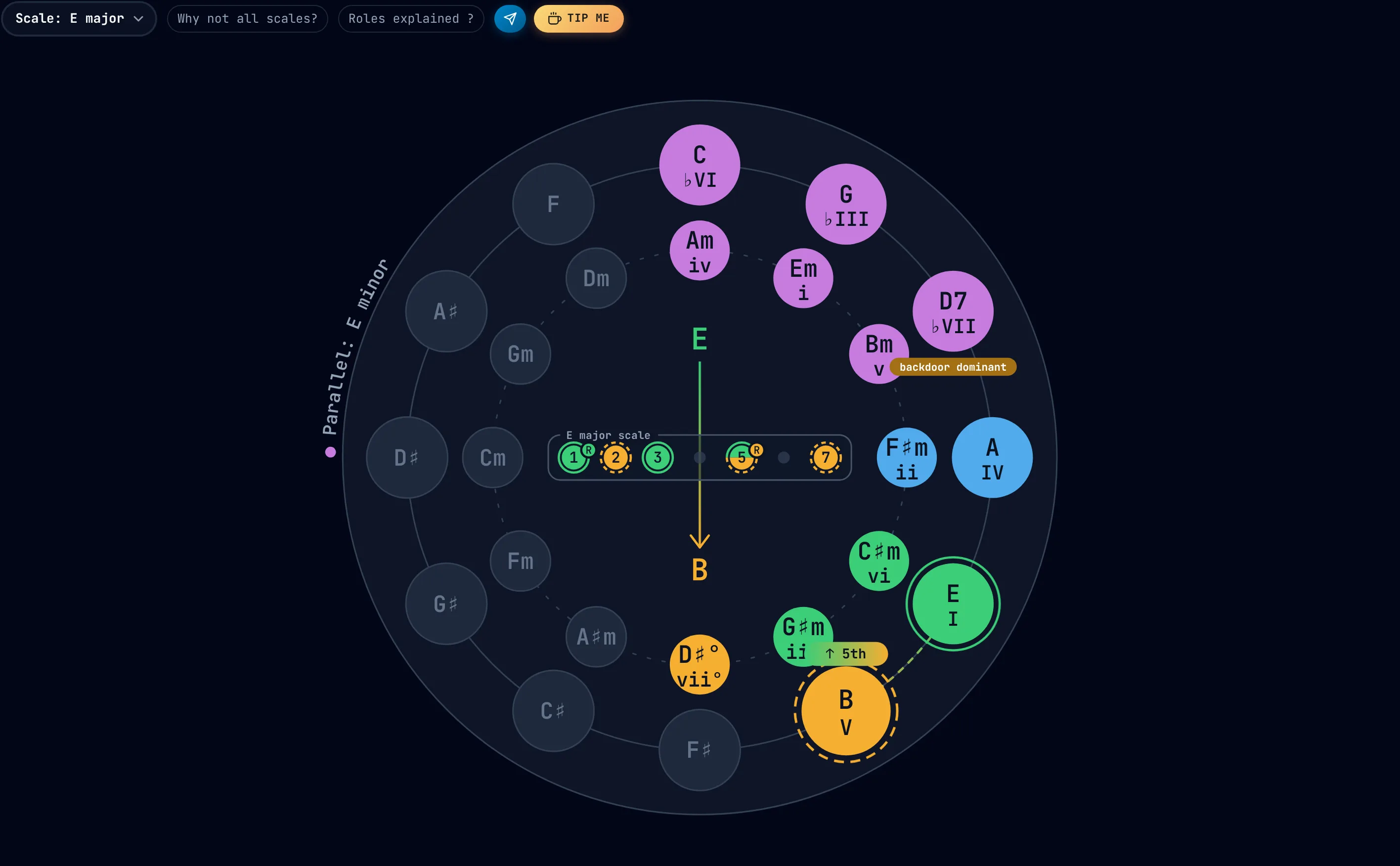
Click any other key to move round the circle: here E major, where B is the V and the key signature has grown to four sharps.
Move round the circle →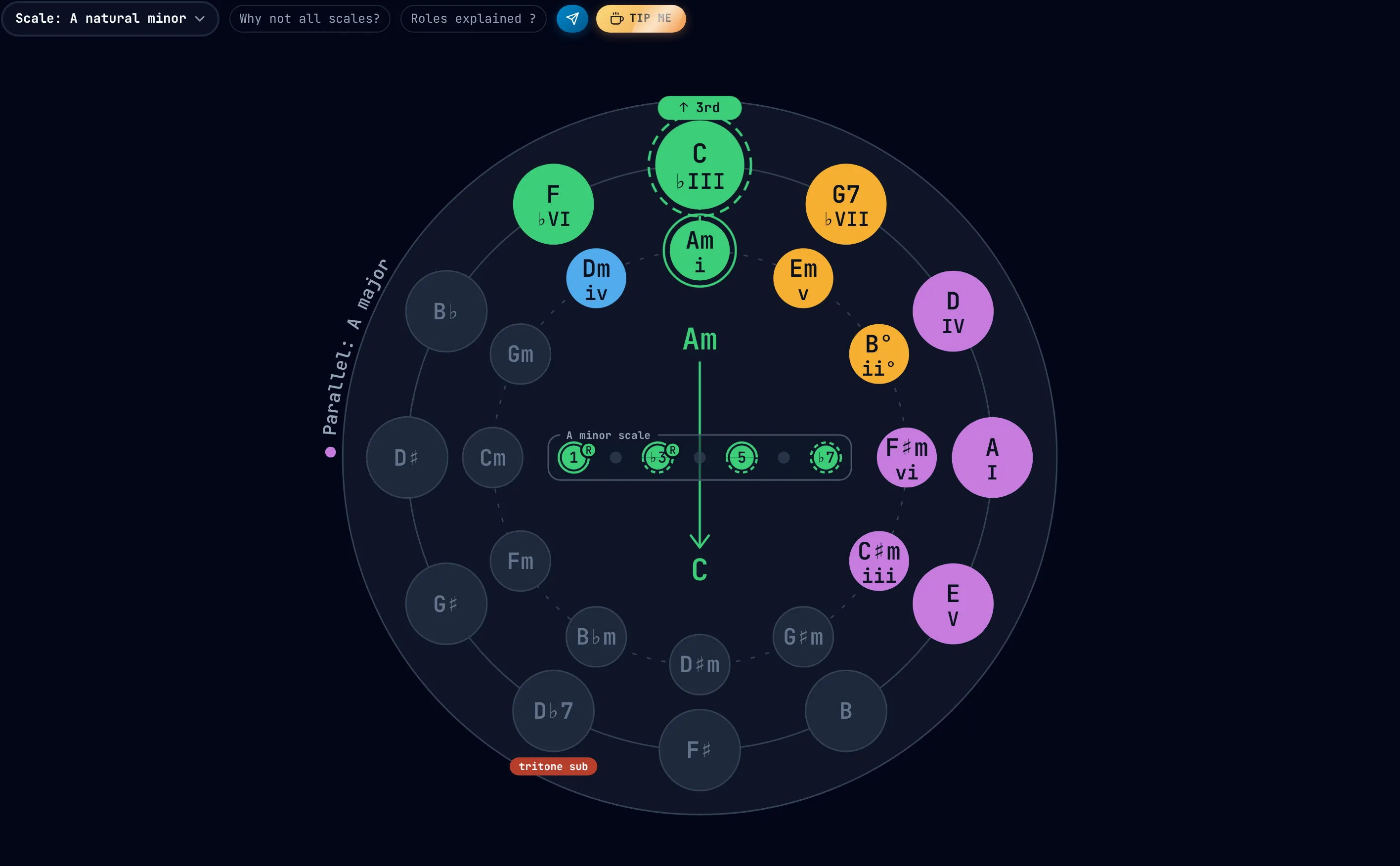
From the circle to the fretboard
The circle tells you which chords go together. The other tools on this site put them under your fingers.
- Progression BuilderBuild a song on the circle, with a band and a guitar voicing for every chord.
- Chord LibraryEvery chord the circle shows, as a formula and as voicings on the neck.
- Scale LibraryThe scale in your key, in its five CAGED positions.
- Triads TrainerPlay the chords of a key as triads, with smooth voice leading.
Frequently asked questions
What is the circle of fifths?
A circle of the 12 notes, each a fifth (seven half steps) above the one before it: C, G, D, A, E, B, F♯, D♭, A♭, E♭, B♭, F and back to C. Each note is also a major key, so the circle shows how closely keys are related: neighbours share six of their seven notes, and the keys on the far side share very few.
How do I find the chords of a key on the circle?
The key itself is the home chord I. Its two neighbours are IV, on the counter-clockwise side, and V, on the clockwise side. Inside the ring, under those three, sit the relative minors: ii, iii and vi, and the vii° chord. In C major that is C, F and G with Dm, Em, Am and B° beside them. The interactive circle labels every chord with its Roman numeral and colours it by role.
What is the relative minor?
The minor key that uses the same notes as a major key, starting from its 6th degree. A minor is the relative minor of C major, and both have no sharps or flats. On the circle each relative minor sits on the inner ring, directly under its major key.
How does the circle of fifths show key signatures?
Moving one step clockwise adds a sharp, and moving one step counter-clockwise adds a flat. C has none, G has one sharp, D two, and so on until F♯ with six; the other way round, F has one flat, B♭ two, and so on. The sharps arrive in the order F♯ C♯ G♯ D♯ A♯ E♯ and the flats in the reverse order, B♭ E♭ A♭ D♭ G♭ C♭.
Why do chords a fifth apart sound so natural together?
A chord whose root is a fifth above another shares a note with it, and a dominant 7th chord a fifth above its target holds the tritone that wants to resolve into it, such as G7 into C. That falling-fifth motion is the strongest pull in harmony, and it is why most progressions travel round the circle.
What are secondary dominants and tritone substitutions?
A secondary dominant is the V7 of a chord other than home: in C major, A7 leads to Dm and E7 to Am. A tritone substitution swaps a dominant 7th for the one a tritone away, which shares its 3rd and 7th: D♭7 in place of G7. The circle marks both when you hover a chord, so you see them before you play them.
Can I use the circle with modes and not only major and minor?
Yes. The scale menu above the circle switches the key to a mode such as Dorian, Mixolydian or harmonic minor. The circle then marks that scale’s own chords and rings its signature chord, the one that holds the note that gives the mode its sound, such as the IV in Dorian.
Is the interactive circle of fifths free?
Yes. It is free, runs in your browser on desktop, tablet and phone, and needs no account or download.
Take a walk round the circle
Pick a key, hover the chords, and listen for the moves the circle names.